

About Tsavo Lions: Legendary stories and uniqueness
Tsavo Conservation Area is Kenya’s largest continuous wilderness, expanding from the Chyulu Hills Game Area in the northwest to Tsavo East in the coastal region. The wilderness is home to a large concentration of wildlife and bird species, including predators. The park is best known for its lions, including the two man-eating lions that terrorized workers during the construction of the Uganda Railway in the 1900s. Today, the vast conservation area is home to over 670 lions, the largest single population in Kenya, and is, therefore, one of the best places to see the big cats in Kenya. But what would really engross you in these creatures is the legendary stories about the man-eating lion and the unique facts about the Tsavo lions. Furthermore, the remarkable Lions of Tsavo hold a significant place in Kenya’s wildlife history.
Lions of Tsavo: The man-eating lions’ history
The story of two giant man-eating lions is one of the most talked-about wildlife encounter thrills, even in pop culture movies. The story begins with the British takeover of Kenya and Uganda in the late 19th century. A railway through the heart of Kenya was then built to connect landlocked Uganda to the port of Mombasa. British engineers and unskilled laborers from their Indian colony built the infrastructure. During the construction of over 1660 km of railway, no location was more tragic than the bridge built inside Tsavo National Park. During this period, two lions stalked the laborers at their campsite and dragged their victims into the wilderness. At some point, they tried to scare away the predators by lighting bonfires, but the effort proved futile. According to available data, 28 workers were killed by the two lions by the time the bridge was completed. It reached a point when there were daily killings, subsequently leading to the halting of the construction work. Later, hunters hunted down and killed the two lions so work could resume. Today, the remains of the two lions are on display at the Marshall Field Museum of Natural History in Chicago.
Studies and theories about man-eating lions
The preference for human prey by the two lions has been one of the most studied predatory behavior today. According to recent findings, lions rarely predate on humans when prey options are unlimited. It is generally agreed that by the time the two lions resorted to attacking humans, the food chain in the vast conservation area had been greatly affected by diseases like Rinderpest, which wiped out most herbivores in the region. It is also believed the man-eating culture had already been established in some prides as a result of access to human bodies that were poorly disposed of during the shipment of slaves to Mombasa before abolition.
Tsavo lions today and their uniqueness
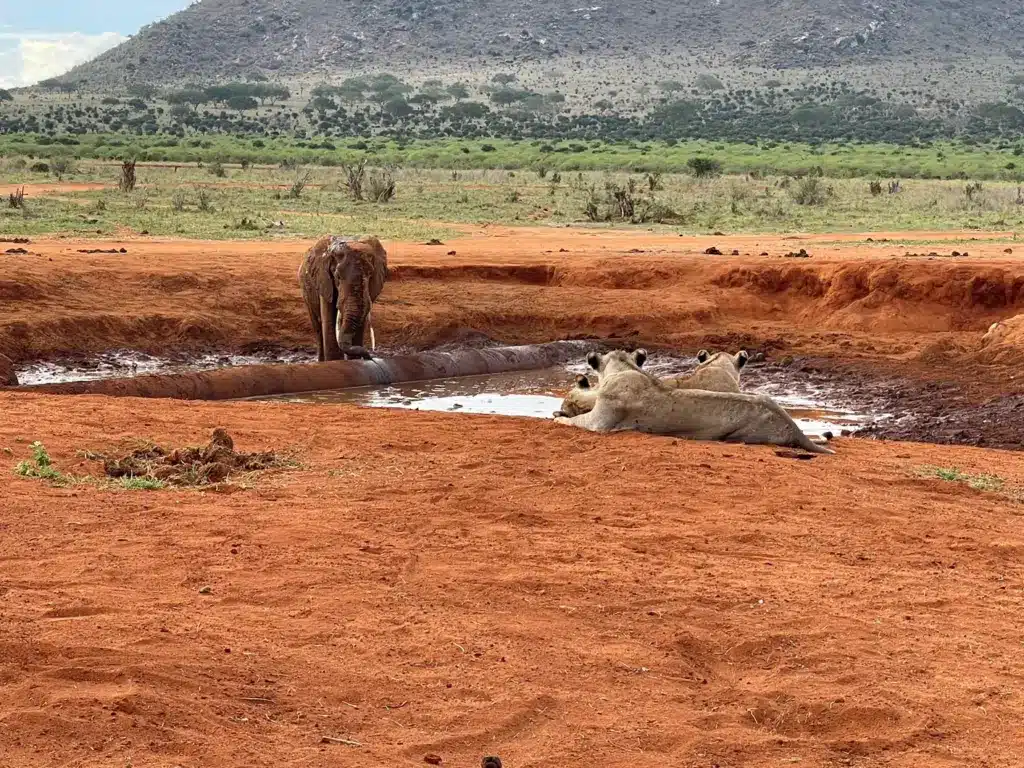
Over 100 years after the two man-eater lions were killed, a significant population of lions still roam the vast Tsavo ecosystem. Like other predators, the lion is greatly threatened, with fewer than 700 individual lions roaming the vast wilderness today. This is way below the region’s capacity of over 20,000 individuals. The decline is largely attributed to illegal hunting that disrupted the food chain, and partly to habitat loss from climate change. However, the Tsavo-Amboseli ecosystem is still one of the best places to see lions in Kenya, with a density of about 3.39 lions per 100 square kilometers. But what will draw you more to the Tsavo lions is their unique complexion and social structure.
First, most male lions in Tsavo are maneless, unlike those in the Mara-Serengeti ecosystem and the Ewaso Ng’iro ecosystem. The lions are also slightly larger than other kinds in East Africa. The lack of manes in male lions in Tsavo is largely attributed to an evolutionary adaptation to better suit their environment. Scientists believe the high temperatures in the semi-arid region require fewer hairs for easier cooling. Again, the thorny, forested Tsavo habitat necessitated a maneless appearance, as the mane could get trapped in thorns and hinder the lions’ hunting ability.
Secondly, in the social structure, unlike lions in the Mara-Serengeti, where a single pride can have 2- 3 males, Tsavo lions have only one male lion in a pride. Researchers believe this is due to the park’s low herbivore density, which creates tough hunting conditions and discourages lions from sharing a kill. Tsavo males are also said to have more testosterone and are, therefore, more aggressive and unwilling to share dominance.
Other predators in Tsavo
Besides lions, the Tsavo ecosystem is also home to other predators, including:
- Cheetahs. The Tsavo ecosystem has about 150 cheetahs (0.74 individuals per 100 km2 ). This is one of the biggest populations in Kenya. To protect the big cat species from extinction, the ongoing Tsavo Cheetah Project aims to research and replenish the population. During your safari drive, you will most probably encounter these incredible cats in open savannah or perched on rocks and anthills.
- Wild dog. Tsavo is also home to about 111 wild dogs, or 0.52 individuals per 100 square kilometers. These wild canines live in parks that offer some of the most stunning hunting scenes you can find on safari.
- Hyenas. Spotted hyenas are the most common variety, with a population density of 18.75 individuals per 100 square kilometers. Stripped hyenas are also relatively common, with a density of 3.26 individuals per 100 square kilometers. These canines are nocturnal, so you have a better chance of seeing them early in the morning, late in the evening, or on night safaris in Lumo and Taita Hills.
- Leopards. These are more elusive than lions and cheetahs, so you can only see them occasionally. You most often see them in lush forested areas within the park.
You can see the above predators on a 3-day Tsavo safari.