

The Rongai route approaches the peak of Kilimanjaro from the north, offering a unique, dry, and stunning perspective of the alpine landscape. The route starts at a Rongai gate near the Kenyan border, facing Amboseli National Park. Despite its unique offerings, it is still one of the least used routes on Kilimanjaro, and this, coupled with its distinctive landscape, gives it an off-the-beaten-path feel you won’t find in other routes. It is a popular route for second-time climbers who want to avoid familiarity with the western route and aren’t interested in the Marangu route, which ascends and descends on the same side. The route descends via the famous Marangu route. Being on the drier side of the mountain, it offers stunning views of Mawenzi and Kibo.
The trekking experience
The Rongai Route begins at the Rongai Gate, also known as Nalemoru Gate (1,950 m a.s.l.), and immediately enters lush forested zones, climbing gently through farmland and moorlands. The trail gradually ascends, offering opportunities to observe giant lobelias, heathers, and alpine flora.
Trekkers experience gradual elevation gain, which helps with acclimatization, making Rongai one of the best beginner-friendly routes. The route merges with the Marangu route at Kibo Hut or with the western routes at Barafu camp, both of which are summiting camps. This means that for the longer part of your trek, you will have almost an exclusive climb. The northern approach also exposes climbers to less rain than the southern routes, increasing the likelihood of dry trekking days.
Summit Success Rate
The Rongai Route is known for high summit success rates due to its gradual ascent and well-paced itinerary:
6 days: 75–80% success
7 days: 85–90% success
8 days: 90–95% success
The route’s gradual climb and fewer crowds make it suitable for climbers concerned about altitude sickness, though proper hydration and pacing are still essential.
Merits of the Rongai Route
- Gentle Ascent: Ideal for first-time climbers or those seeking a less strenuous climb.
- High Summit Success: Gradual elevation gain allows better acclimatization.
- Solitude: Fewer trekkers compared to the Marangu or the western-facing routes.
- Scenic Diversity: Trek through rainforest, moorland, and alpine desert, with views of Kibo’s glaciers.
- Unique landscape. Ideal for second-time climbers seeking a whole new experience.
- Drier Trekking Conditions: Northern exposure reduces rain compared to southern routes. This makes it ideal for climbers seeking to ascend in the rainy season in April and May.
Demerits of the Rongai Route
- Limited Social Interaction: Some climbers may feel isolated due to fewer trekkers.
- Basic Camp Facilities: Camps along Rongai are more remote, with fewer amenities.
- Longer Trekking Days on Some Itineraries: Though the ascent is gradual, some days can be physically demanding.
- Less Dramatic Early Scenery: Compared to Lemosho or Shira, the first sections are less visually striking.
Tips for a Successful Climb via Rongai Route
- Plan for 7–8 days to maximize summit chances and acclimatization.
- Train in advance with long hikes and cardio workouts.
- Hire experienced guides familiar with the Rongai Route.
- Stay hydrated and maintain a balanced diet to support altitude adaptation.
- Pace yourself and use the “climb high, sleep low” principle whenever possible.
A Typical Itinerary for the Rongai Route
Day 1: Moshi to Rongai Gate, Simba Camp (2,650 m a.s.l)
Trekking time: 3–4 hrs
Elevation gain: +700 m
Distance: 6 km
You will be picked up at your hotel in Moshi by a driver with your climbing crew and head towards Kilimanjaro, heading to the northern-facing side of the mountain. About 2.5 hrs later, you will enter the village of Nalemoru, passing through farmland and villages along a dusty road. As soon as you arrive at the Rongai gate, check in, and then start the climb to Simba Camp. You arrive at Simba camp around 1400 hrs, check in, and have lunch. Afternoon at leisure.
Day 2: Simba Camp to Second Cave Camp (3,450 m a.s.l)
Trekking time: 4–5 hrs
Elevation gain: +800 m
Distance: 8 km
The day climb starts immediately after breakfast, taking you through stunning heathlands with photogenic wildflowers. The stretch is quite a tough climb compared to the previous day. During the walk, you will enjoy stunning vistas of the Kibo and Mawenzi peaks on a clear day, as well as sweeping views over the Amboseli-Tsavo landscape in Kenya. Lunch is served at a unique picnic spot before proceeding to the Second cave camp, located in a stunning, sheltered valley. The rest of the afternoon can be spent energizing for the next day’s climb.
Day 3: Second Cave Camp to Kikelewa Caves (3,600 m a.s.l)
Trekking time: 5–6 hrs
Elevation gain: +150 m
Distance: 8–10 km
This day you won’t have much altitude gain, as it is set aside for acclimatization: you climb high and then descend to a lower camp. You will depart from the camp early in the morning and start gradually ascending. As you climb, you will notice the vegetation thinning and fewer trees, but the landscape remains stunning. You will then steadily descend to a narrow path that leads to Kikelewa Cave, at Kikelewa River, where you have lunch and spend the afternoon at leisure.
Day 4: Kikelewa Caves to Mawenzi Tarn Camp (4,330 m a.s.l)
Trekking time: 5–6 hrs
Elevation gain:+730 m
Distance: 4 km
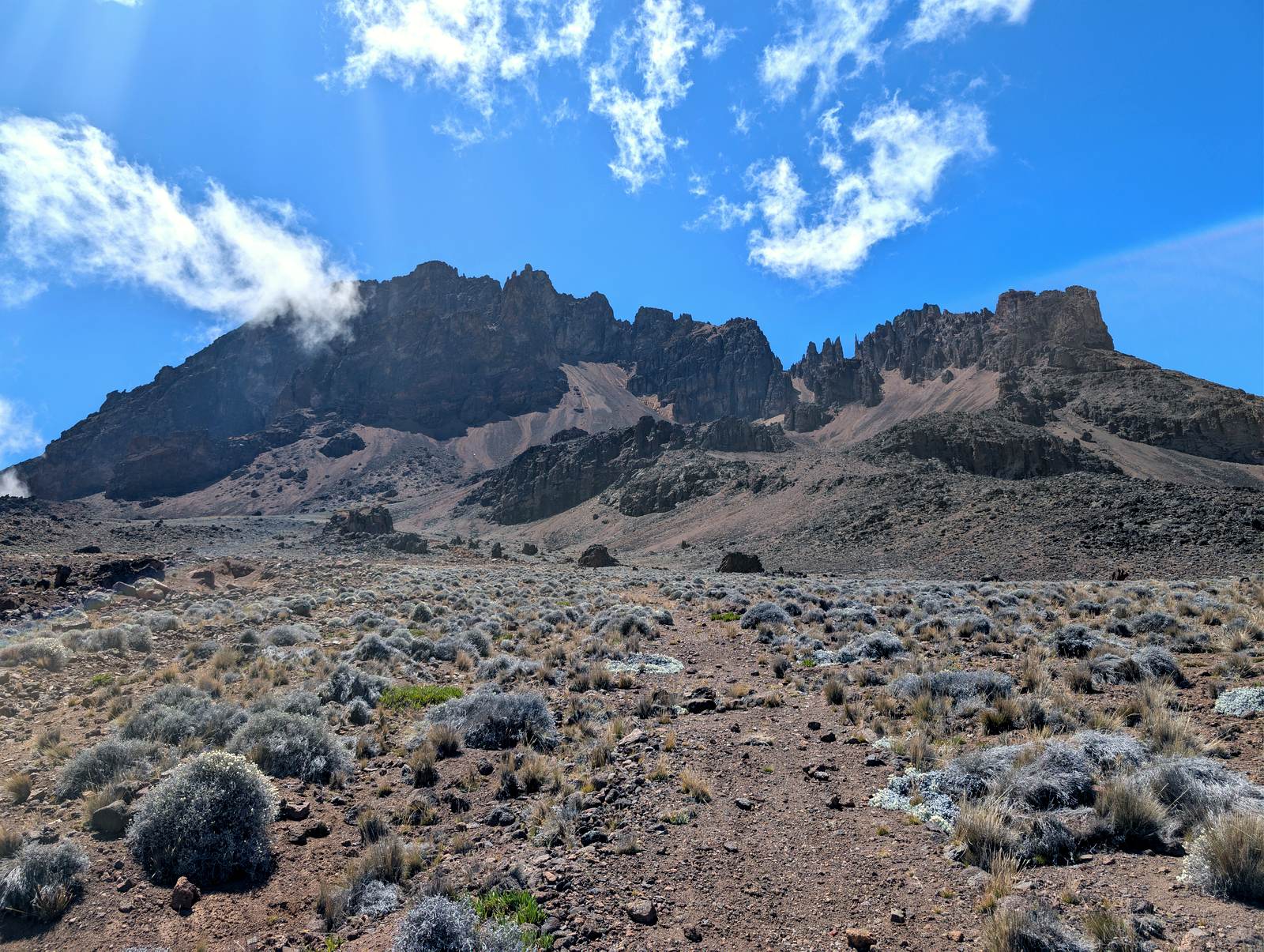
After breakfast, you will ascend gently into the alpine desert, enjoying views of Mawenzi Peak. The climb gives way to stunning rocky hills and volcanic features. You will also find sections of stunning moorland as you follow the trail throughout the morning. You will then arrive at Mawenzi Tarn Camp, set in a panoramic valley in the shadow of Mawenzi Peak, at lunch hour. The afternoon can be spent further acclimatizing or relaxing in the camp.
Day 5: Mawenzi Tarn to Kibo Hut (4,705 m a.s.l)
Trekking time: 4–5 hrs
Elevation gain: +375 m
Distance: 6 km
In the morning, after breakfast, you will start gradually ascending, passing through a photogenic rocky landscape between the Mawenzi and Kibo peaks. This stretch offers the best view of the two cones. You will have lunch served at a unique spot before proceeding with the climb. You will arrive at the camp later in the afternoon. You will relax and have an early dinner in preparation for the final push to Uhuru Peak after midnight.
Day 6: Kibo Hut to Uhuru Peak (5,895 m a.s.l) to Horombo Hut
Trekking time: 12 hrs
Elevation: +1190 m a.s.l / – 2175 m a.s.l
Trekking distance: 6 km (ascent)/ 15.5 km (descent)
On this day, you will wake up at midnight and enjoy a cup of hot black tea. Thereafter, you will go for a trek through the stunning alpine desert, ascending along a zigzag route to Gilman point (5681 m a.s.l.), one of the key points on the Kibo crater rim. Then you will proceed to trek along the rim to Stella Point, another point on the crater (5756 m a.s.l.), and onward to Uhuru Peak, the highest point (5895 m a.s.l.). You will have a short celebration and photo session before descending to Kibo Hut for breakfast. After that, you will descend to Horombo Hut, where you will spend the night.
Day 7: Horombo Hut to Marangu Gate
Trekking time: 6 hrs
Elevation: -1860 m a.s.l
Trekking distance: 20 km
After breakfast, you will have a short farewell session, then start to descend through the stunning rainforest towards the Marangu gate. At the entrance, you will meet your driver for the transfer to Moshi. You are dropped off at your hotel.
Conclusion
The Rongai Route offers a peaceful, gradual, and scenic climb to Kilimanjaro’s summit. Its high success rate, lower crowds, and well-paced ascent make it ideal for first-time climbers and those seeking a more relaxed trekking experience. While the route’s early scenery is less dramatic, the views of Kibo, Mawenzi, and the alpine landscapes reward trekkers who commit to the journey. For climbers looking for a gentle yet rewarding ascent, Rongai is a top choice.
Ready to climb Kilimanjaro? Explore our 7 day Machame Route climb, 7 day Marangu Route climb and 10 day Lemosho Route climb, or contact us and we will help you choose the right route and dates.