

The Shira Route is one of Mount Kilimanjaro’s oldest and most scenic paths to the summit. Starting from the western side of the mountain at the Shira Gate, the trail ascends across the expansive Shira Plateau, offering early exposure to Kilimanjaro’s alpine landscapes. The route is less trafficked than Machame or Marangu in its early stages, giving trekkers a sense of solitude and wilderness. The route, however, despite its stunning view, is the least preferred due to its low summit success rate. However, you can still manage if you spend at least 2 days in the regions at 3800-4000 m a.s.l. for acclimatisation. We recommend the route for avid climbers and trekkers who have had time to acclimatise to the high-altitude environment on another mountain, such as Mt Meru, ‘kili little sister’, or a mountain back home. The Shira Route eventually converges with the Lemosho and Machame trails around Shira 2 Camp, providing a connection to the standard summit path.
Trekking experience
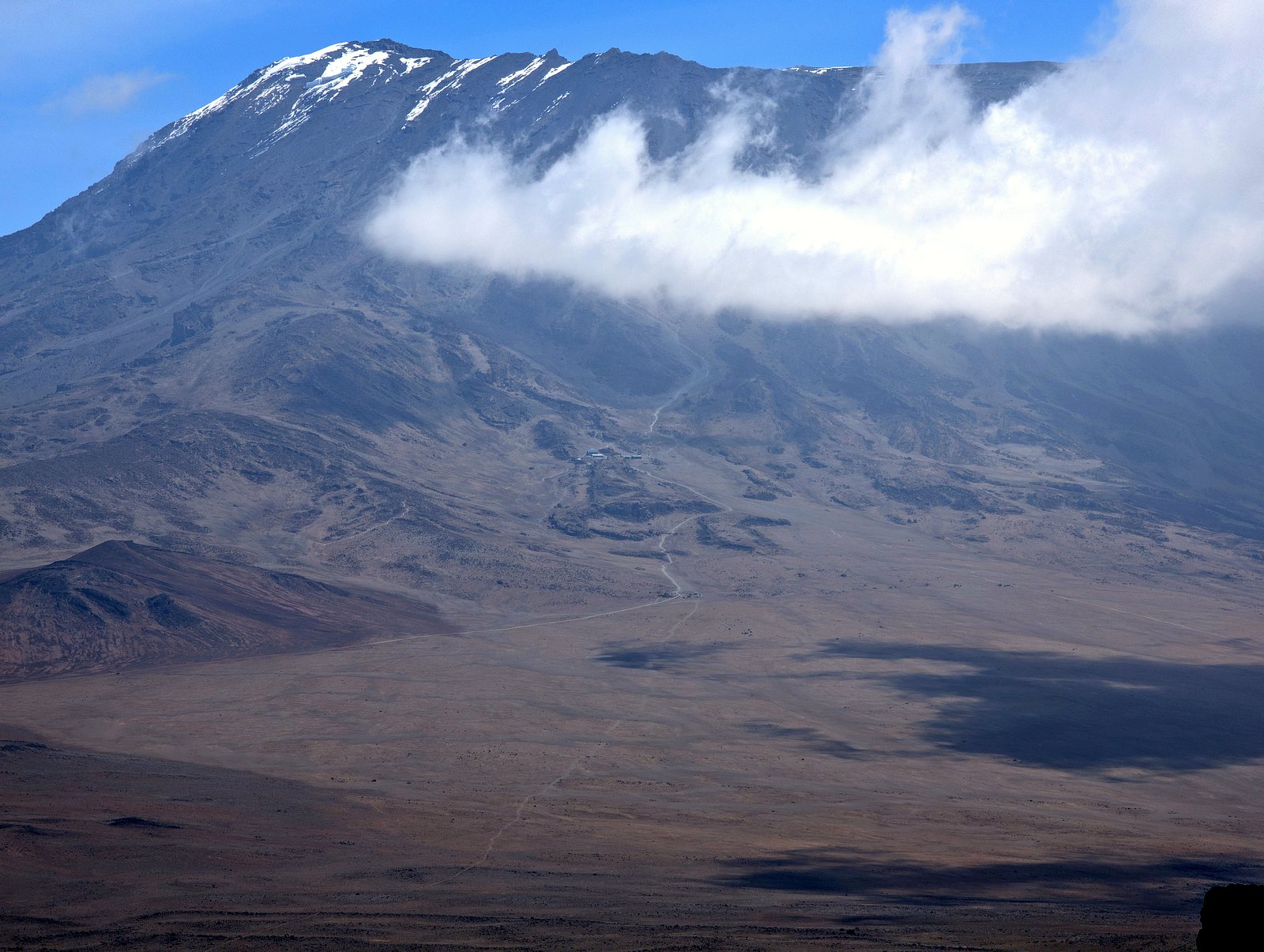
Climbing Kilimanjaro via the Shira Route begins at a relatively high altitude, placing trekkers immediately into open moorland and alpine scenery. The early days across the Shira Plateau offer expansive views, volcanic rock formations, and a quieter, more remote atmosphere compared to busier routes. This high starting point makes the experience feel dramatic from the outset, but it also demands careful pacing and strong prior acclimatisation. As the route merges near Shira 2 Camp, the trek follows the classic southern circuit across Lava Tower and down to Barranco, two of the most unique features in the route.
Summit success rate
The Shira Route’s success largely depends on the number of days allocated for the trek.
- 5 days: 50–65% success
- 6 days: 65–75% success
- 7 days: 75–85% success
Though the Shira route has been criticised as the worst route for summiting Kilimanjaro, the main issue is that it offers a quicker ascent, which makes travellers more prone to altitude sickness. We therefore recommend that you consider travelling in 6 or 7 days to maximise the chances of summiting.
Merits of the Shira Route
- Scenic solitude: Early sections are quieter than other popular routes, enhancing the wilderness experience.
- Unique alpine landscapes: Trekkers encounter rolling moorlands, volcanic rock formations, and giant lobelias unique to Kilimanjaro. The route features the stunning Shira Plateau and the Barranco wall.
- Gradual acclimatisation: Though Shira is said to be the worst for acclimatisation, as the trail starts higher than the rest, it is still an excellent option if you would like to acclimatise slowly. We recommend considering the ‘climb high, sleep low’ tactic on this route, preferably at around 3800 m a.s.l. In this, you climb high on day hikes, then return to a lower camp before eventually summiting.
- Good challenge for avid climbers: If you are an experienced climber and want a route that poses some challenges, the Shira Route is ideal. The route is more challenging than others.
- Suitable for a quicker ascent: Though we do not recommend a quicker ascent, the Shira route could still be the best option for you if you want a faster climb after you have had a moment to acclimatise on a Mt Meru or Mt Kenya hike.
Demerits of the Shira Route
- Limited facilities: Camps on the plateau are basic, with fewer amenities than at Marangu or Machame.
- Altitude challenges: Starting higher increases the initial risk of mild altitude sickness if not paced carefully.
- Physical demands: Shira starts at a high altitude and has more challenging terrains when compared to other routes
- Route convergence: Crowding may still be a challenge at Shira Camp 2, where the route meets other routes.
Tips for a Successful Climb via the Shira Route
- Plan for at least 6 days to maximise summit chances.
- Train in advance with hikes on varied terrain and cardio workouts.
- Use experienced guides familiar with navigation on the Shira Plateau.
- Hydrate and maintain proper nutrition throughout the trek.
A typical itinerary for the Shira Route
Day 1: Moshi to Simba Cave Camp (3,600 m a.s.l)
Trekking time: 2 hrs
Elevation: 0 m a.s.l
Trekking distance:6.5 km
Drive from Moshi to Londorossi Gate, where you complete park registration, then continue to Shira Gate (3600 m a.s.l). From the Shira Gate, you will start the climb gradually. The trek lasts about 2-3 hrs and traverses stunning giant heather and shrub vegetation, leading to Simba Cave Camp (3600 m a.s.l).
Day 2: Simba Cave Camp to Shira 2 Camp (3,890 m a.s.l)
Trekking time: 2 hrs
Elevation: +290 m a.s.l
Trekking distance: 6 km
On this day, you will focus on acclimatisation on the Shira Plateau. You start the journey very early in the morning, trek through the stunning landscape, gradually climb, and then descend. Eventually, you take a path to the famous Shira Cathedral, then to Shira 2 Camp, where you spend the night.
Day 3: Shira 2 Camp to Barranco Camp (3960 m asl)
Trekking time: 7 hrs
Elevation: +70 m a.s.l
Trekking distance:10 km
On this day, you will climb higher into the moorland, traversing to the southeast towards the lava tower, a stunning volcanic plug next to the Shark’s Tooth formation (4,630 m asl). From Lava Tower, you descend to Barranco Camp. By the end of the day, you will have enjoyed the walk that keeps a trend of gaining and losing altitude, a trek that will have further helped you acclimate for summiting.
Day 4: Barranco Camp to Karanga Valley (3995 m a.s.l)
Trekking time: 5 hrs
Elevation: +35 m a.s.l
Trekking distance:5 km
The trail starts with a short descent to cross a stream, then takes on the famous Barranco Wall. Though challenging, the wall climb helps you measure your fitness for summiting. Once you are at the top of the steep wall, you will have an opportunity to take a breath as you enjoy the sweeping view of the stunning alpine landscape. Thereafter, you will descend to the Karanga valley, then proceed to a steep climb to Karanga camp for the night.
Day 5: Karanga Camp to Barafu Camp (4673 m a.s.l)
Trekking time: 4 hrs
Elevation: +678 m a.s.l
Trekking distance:3.5 km
After breakfast, you begin the hike heading towards Barafu camp, the summit camp. The walk leads through some incredible, stunning arid lunar terrain and takes about 4 hrs to the camp, where you find your crew already set up. You will spend the afternoon relaxing as you wait to summit the following morning.
Day 6: Barafu Camp to Mweka Camp (3050 m a.s.l) via Uhuru Peak (5895 m a.s.l)
Trekking time: 6 hrs/ – 8 hrs
Elevation: +1222 m a.s.l/ – 2845 m a.s.l
Trekking distance:5 km / – 11.5 km
On this day, you will wake up at midnight and begin the climb to Uhuru Peak. The climb is about 6 hrs steep climb and takes you through a stunning scree landscape. By 0600 hrs, you will have reached the peak at Point Uhuru. Here you will have the opportunity to enjoy breathtaking views of ice cliffs on the crater rim and distant views of Mawenzi Peak. Thereafter, you descend to Mweka via Barafu Camp for breakfast. Spend the rest of the day relaxing.
Day 7: Mweka Hut to Mweka Gate
In the morning, you will have breakfast, then start the journey down through the stunning moorlands and into the rainforests. You will have a picnic lunch at the gate before heading back on your road trip to Moshi or Arusha.
Trekking time: – 4 hrs
Elevation: – 1410 m a.s.l
Trekking distance: 9km
Conclusion
The Shira Route offers a unique combination of early high-altitude trekking, striking plateau scenery, and a quieter wilderness experience. While shorter than the Lemosho route, you can still gain substantial acclimatisation benefits and good summit success when undertaken over 6–7 days. The main challenge of the Shira Route is its high starting point rather than its overall elevation profile. Once past the plateau, it follows the standard southern circuit with well-spaced acclimatisation days. The route is also a perfect option for trekkers seeking a quicker ascent after acclimatising on other mountains.
Ready to climb Kilimanjaro? Explore our 7 day Machame Route climb, 7 day Marangu Route climb and 10 day Lemosho Route climb, or contact us and we will help you choose the right route and dates.