

Climbing Mount Kilimanjaro is a unique experience not just because of its height, but because of the dramatic climate changes you encounter along the way. Unlike most mountains, where the weather gradually shifts, Kilimanjaro presents a journey through multiple climate zones, each with distinct temperatures, vegetation, and weather patterns.
Within about 1 week, you will be climbing the mountain, moving from tropical farmland to an arctic summit. This is definitely one of the most exciting experiences you will have to brace for. In this guide, we will cover all climatic zones and guide you on how to prepare for each.
Understanding Kilimanjaro's climate system
Kilimanjaro lies just south of the equator in northern Tanzania. This gives the lower slopes a warm, tropical climate. However, due to its massive elevation, which rises to 5895 m a.s.l., the mountain creates its own weather system.
Temperature drops as you gain altitude, and rainfall patterns vary significantly across zones. The result is a mountain with five distinct climatic zones, each behaving almost like a separate world.
The five climatic zones of Kilimanjaro
Cultivation Zone (800m – 1,800m)
This is the base of Kilimanjaro, where local communities farm the fertile volcanic soils. On most of the trail, you will only enjoy views of this region from the vehicle you transfer in, as the park’s main gates are mostly located above it.
Climate characteristics:
- Warm and humid
- Temperatures range between 20°C and 30°C
- Occasional rainfall
As you drive through dusty rural roads in this region, you will enjoy the sights of a typical East African countryside, with banana plantations, coffee farms, and small villages.
Rainforest Zone (1,800m – 2,800m)
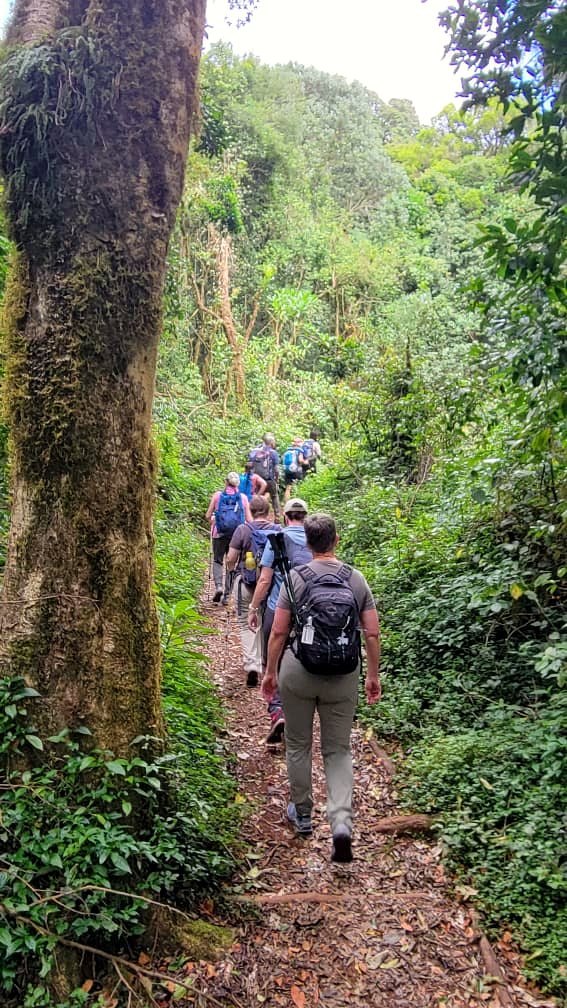
This is usually the first region within the protected area in Kilimanjaro National Park. This is the wettest part of the mountain, especially when approached from the southern, western, and eastern trails, which are on the windward side of the mountain. Most park gates are situated at the base of this region. From the gate, you will start the climb through the dense tropical forest, with occasional encounters with wildlife and birds. It is very common to see primates scampering between trees in this region. Due to the frequent rains, the trails can be muddy and slippery.
Climate characteristics:
- High humidity
- Frequent rainfall
- Temperatures between 15°C and 25°C
Because of the moisture, this zone often feels warmer than it actually is, and wearing light clothes can be ideal on a sunny day. A brim hat can also be ideal for protecting you from the scorching sun. Waterproof gear can, however, still be essential.
Moorland Zone (2,800m – 4,000m)
As you climb higher, the forest gradually gives way to open landscapes with stunning alpine moorland vegetation. This is the most picture-perfect section you will have on the Kilimanjaro climb. Here, there are varieties of plants, such as lobelias and senecios. These plants are adapted to the relatively cold environment. This is also the last region where you may occasionally sight wildlife, mostly antelopes and elands. This region is often compared to the Scottish Highlands because of its vegetation. You will also come across sections with stunning volcanic rocks.
Climate characteristics:
- Cooler temperatures (5°C to 15°C during the day)
- Cold nights (can drop below freezing)
- Reduced rainfall
Here, you will need to wear fairly warm clothes. Notably, this region marks the transition to the high-altitude climate. Days can be sunny, while nights and mornings can be very cold. Convertible trekking pants can be a more comfortable option for changing weather.
Alpine Desert Zone (4,000m – 5,000m)
This is usually the acclimatization region. It has one of the most extreme environments on Kilimanjaro. Very few plants survive here, and you will only see a handful of flowering plants amidst a bare, lunar-like volcanic landscape. Here, while the days can be warm, the nights and mornings are extremely cold. The rocks offer some of the most picturesque alpine landscapes you will find during the climb. Daytime temperatures can still reach 10°C–15°C under direct sunlight, but nights can drop to – 5°C to -10°C. This large swing is usually due to the atmosphere being thin and therefore not holding heat. The thin air also holds little humidity, and therefore, the weather is generally dry. You may, however, experience falling snow or sleet. This is also the region where most climbers first start to feel the effects of altitude sickness.
Climate characteristics:
- Very dry air
- Large temperature swings
- Intense solar radiation
In this region, it’s a good idea to wear warm jackets to protect yourself from the cold. It is also recommended to have the layered clothes handy. You may need them, especially after the lava tower region. In addition, remember to carry your sunglasses and sunscreen to protect against UV rays as you climb up towards the Arctic region.
Arctic Zone (Above 5,000m)
This is the harshest part of Kilimanjaro. Oxygen levels are significantly lower, and the region has ice fields and glaciers, much like the Arctic. The sunlight here is also far stronger than at the base of the mountain. However, due to insufficient atmosphere, the climate is generally freezing cold, with temperatures often sub-zero. Nights and early mornings are particularly extremely cold. The summit is also characterized by strong winds, which intensify its cold. You are also more vulnerable to sunburn here than in any other region in the mountains. Importantly, the summit is usually done after midnight when it is freezing cold. This is a deliberate choice to allow a slow-paced ascent, enabling gradual acclimatization. You also avoid harsh sunlight, and the surface is firmer and easier to push to Uhuru Peak.
Climate characteristics:
- Freezing temperatures (-10°C to -20°C or lower)
- Strong winds
- Snow and ice
Have full-layered clothes for both the upper and lower body. Ensure you have headgear, sunscreen, and sunglasses.
Tips to ensure full protection in harsh alpine climatic conditions in Kilimanjaro
- Avoid faulty gear. Whether you are hiring or buying new ones, it is a good idea to inspect the condition of the gear before starting the climb and check for torn clothes, tents, or boots.
- Ensure the gear and equipment are up to standard. The gear must be adapted to the harsh alpine environment. The waterproof layer must provide full protection against rain. The sleeping bags and tents must guarantee protection at sub-zero temperatures.
- Properly wear clothing and set up the tent. Let the tour guide and the porters set up the tent. They must ensure the wind can’t blow it, or that water doesn’t get into the tent in case of rain. Also, ensure you wear the layered clothes properly.
- Don’t ignore the sunburns. This is the most overlooked aspect of protection, especially among casual and first-time climbers. With severe sunburn, the faces, necks, and arms burn quickly, which may cause discomfort during the climb. You may also suffer from blisters and skin peeling.
Conclusion
The climate on Mount Kilimanjaro is one of the most diverse you will encounter anywhere in the world. From tropical heat to freezing alpine conditions, the mountain offers a journey through multiple ecosystems in just a few days.
Understanding these climatic zones is not just interesting—it is essential for your success. With the right preparation, the changing climate becomes part of the adventure, making your climb not only challenging but truly unforgettable.
Ready to climb Kilimanjaro? Explore our 7 day Machame Route climb, 7 day Marangu Route climb and 10 day Lemosho Route climb, or contact us and we will help you choose the right route and dates.