

Climbing Mount Kilimanjaro is one of the most exhilarating trekking adventures you can have in the world. Towering at 5,895 meters (19,341 feet), it is Africa’s highest peak and the tallest free-standing mountain on Earth. But one thing that most first-time climbers would want to know is what interesting facts about the mountain would inspire them to climb it even more. In this guide, we have compiled some of the most exciting facts that you should know.
Kilimanjaro is a giant stratovolcano with three peaks.
The first thing you should know about Kilimanjaro before you lace up your hiking boots is its unique geology. The mountain is a giant stratovolcano that formed over hundreds of thousands of years through repeated eruptions, building layers of lava, ash, and volcanic rock. The mountain is the world’s highest free-standing mountain, meaning it is a standalone feature and not part of a mountain range like the Himalayas and the Alps. This actually makes it feel like the tallest mountain and a very exciting feature to conquer.
Kilimanjaro has three main volcanic cones:
- Kibo – The central cone and the highest point of the mountain. Uhuru Peak, the ultimate goal for climbers, is located here. While dormant, Kibo is not extinct, and fumaroles near the summit show that it still has volcanic heat below.
- Mawenzi – The eastern cone, rugged and jagged. Few climbers attempt it due to technical difficulty.
- Shira – The western plateau, mostly eroded and forming highland plains.
You will also discover exciting volcanic features during the climb, such as lava valleys, steep volcanic walls and lava towers.
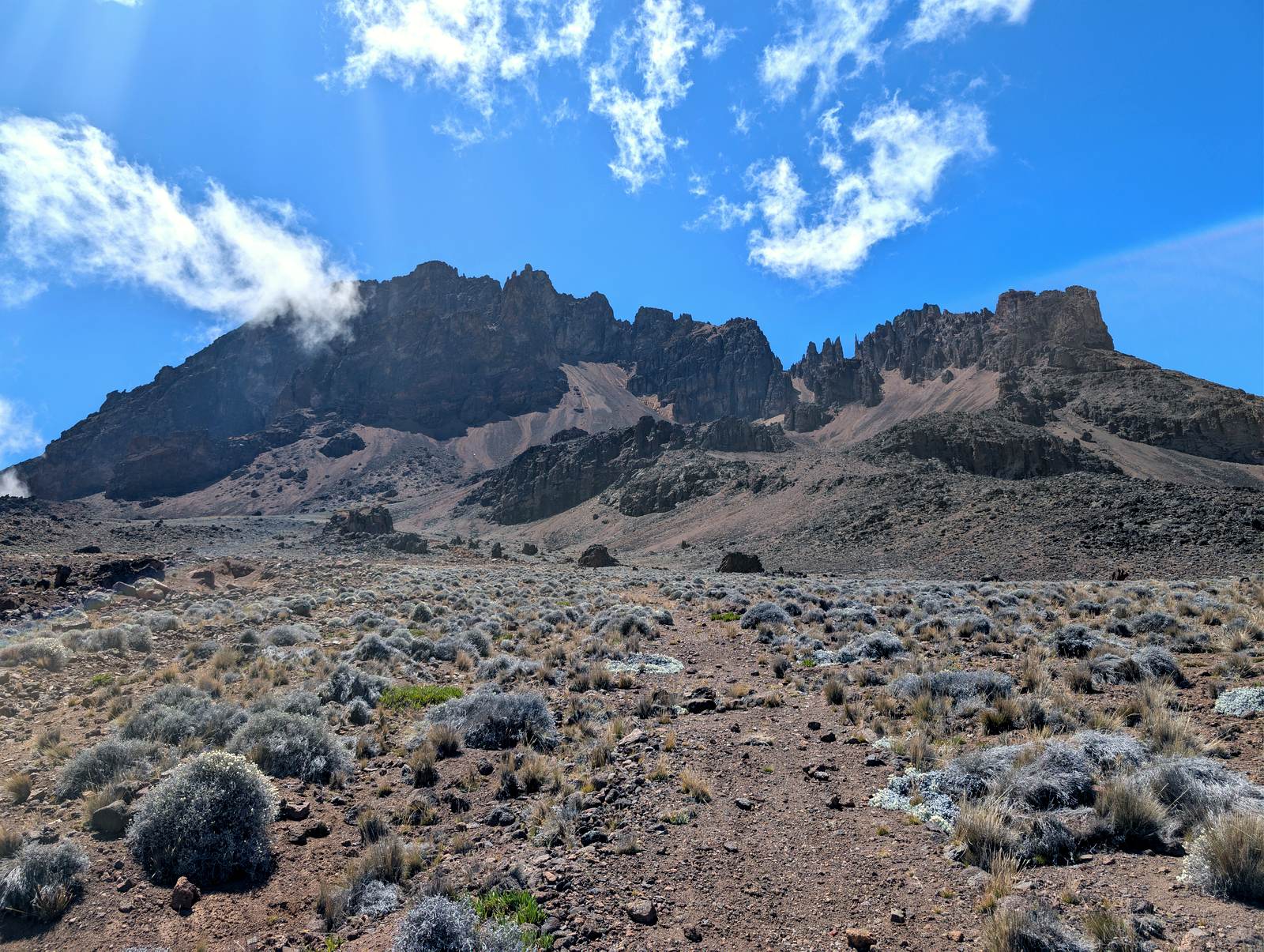
You will experience five different ecological zones.
Another inviting feature of Kilimanjaro is its distinct ecological/ climatic zone. The mountain lies immediately south of the equator, meaning its base has a relatively warm tropical climate. However, as you reach higher altitudes, the weather becomes cooler, leading to five distinct regions, each offering its own climatic conditions. This means that, for the roughly one week you will be climbing Kilimanjaro, you will cross five different climatic zones. These are:
- Cultivation Zone (800–1,800 meters)– The foothills are full of villages and farmland, with crops like bananas, maize, and coffee.
- Rainforest Zone (1,800–2,800 meters)– Dense, lush forest with mosses, ferns, and huge trees. Keep your eyes open for colobus monkeys, elephants, and a wide variety of birds.
- Heath and Moorland Zone (2,800–4,000 meters) – Giant lobelias, senecios, and rugged terrain dominate. Temperatures drop, and vegetation thins out.
- Alpine Desert Zone (4,000–5,000 meters)– Harsh and rocky with little vegetation. Strong sun, wind, and temperature swings test your endurance.
- Arctic Summit Zone (5,000–5,895 meters) – The icy peak, where temperatures can drop below -20°C and oxygen levels are half of what you’re used to at sea level.
Kilimanjaro has glaciers near the equator.
It may surprise many that a mountain near the equator has permanent snow and glaciers. Kilimanjaro’s glaciers are remnants from when Africa had cooler climates. There are only three glacier peaks in Africa: Kilimanjaro, Mt Kenya, and the Rwenzori Mountains on the Uganda–DR Congo border. Glaciers are in the Arctic region or the upper parts of mountains and are preserved by sub-zero temperatures at the peaks. They create some of the most picture-perfect spots in the climb. Importantly, due to climate change and global warming, glaciers are gradually declining as temperatures rise.
Wildlife on the mountain is abundant.
Before you start your climb, it is helpful to know that Kilimanjaro is home to a variety of wildlife. They mostly dwell in the lower rainforest region, which offers dense woodlands. Some of the common animals that you will find in Kilimanjaro include:
- Colobus monkeys – Agile primates with striking black-and-white coats.
- Elephants – Occasionally spotted at the forest edge.
- Bushbucks, leopards, and small carnivores – Elusive, mostly in the rainforest.
- Bird species – More than 140 species, including hornbills, sunbirds, and the white-necked raven.
While you may not see all these animals during your hike, the awareness enriches the trek. Bring binoculars if you enjoy wildlife spotting.
The climb is physically and physiologically demanding.
Even though technical climbing skills aren’t required, Kilimanjaro is not a walk in the park. Here is what to know before you climb:
- The summit of Uhuru Peak has about 50% of the oxygen you breathe at sea level.
- Climbers burn 3,000–4,500 calories per day, depending on their pace and route.
- Altitude sickness can affect anyone, regardless of fitness. Notably, most climbers experience mild altitude sickness with symptoms that include headaches, low appetite, and insomnia. The mild cases are managed. A few severe cases call for immediate descent.
Proper acclimatization, hydration, and pacing are more important than sheer fitness. Understanding this before you climb can prevent overconfidence and improve your chances of reaching the summit.
There are multiple climbing routes.
Kilimanjaro offers seven main trekking routes, including:
- Marangu Route
- Machame Route
- Lemosho Route
- Shira Route
- Rongai Route
- Umbwe Route
- Northern Circuit Route
Generally, most routes offer summiting in 6 to 10 days. The longer the route, the better the acclimatization. The Marangu route is also the oldest and the only route that offers hut accommodation. On all the other routes, guests sleep in a tented camp. The Northern Circuit is also the best for acclimatization, as it is the longest. It is, however, the most expensive route. The Rongai route that approaches from the northern side of the mountain is the most remote and least used.
The final push is at night.
What many first-time climbers don’t know is that the final push to the summit usually starts at midnight. This usually allows you to summit in the early morning, when conditions are colder but calm. The ground is also firmer and easier to trek on. There is also little sunlight in the early morning, and the highlight is the beautiful sunrise at its peak. The night push is also slow-paced, reducing the risk of altitude sickness. Knowing that you will be summiting at night, it is good to have a headlamp for yourself. Also, have a warm layer of clothing to protect from the cold. Also carry sunscreen and sunglasses to protect you from sunburn.
Summit success depends on acclimatization.
What most first-time climbers don’t know is that summit success is not dependent on physical strength but on acclimatization. A significant percentage of climbers attempting Kilimanjaro still don’t get to the summit after suffering severe altitude sickness. Most of these cases arise from poor acclimatization. Proper acclimatization requires spending more time in the acclimatization region, where you gain altitude, then descending to lower camps for overnight stays. This helps you familiarize yourself with the high-altitude environment before the final push. We recommend you consider longer routes for the best success rate.
- Longer routes like Lemosho and Northern Circuit have summit success rates above 90% on 8+ day packages.
- Shorter, steep routes like Umbwe and Shira may have success rates below 60% on a 6-day package.
Also, avoid overexertion and keep your body hydrated to boost your summiting rate. Should you have any signs of altitude sickness, inform your guide for assistance. While summiting isn’t mandatory, descending safely must be guaranteed.
Kilimanjaro is environmentally fragile.
Climbers should understand that Kilimanjaro’s ecosystems are delicate. Before you even embark on the climb, it is good to commit to an eco-friendly climb. The basic rule is that no trace is left behind. You should only follow the marked trails during the climb; don’t pick plants or move rocks. You should also not litter; carry all the waste after the climb. You should also consider an operator committed to responsible, sustainable tourism.
You don't need technical climbing skills.
Unlike Everest or the Alps, Kilimanjaro can be climbed without ropes, crampons, or ice axes. It is a trekking summit rather than a technical climb. However, this does not mean it is easy—altitude, weather, and physical endurance are significant challenges. Understanding this distinction helps climbers set realistic expectations.
Kilimanjaro offers life-changing experiences.
Finally, knowing what to expect before the climb can make your experience transformative. From the lush rainforest at the base to the barren alpine desert and the icy summit, every stage of the climb is a lesson in resilience and awe. Many climbers report a deep sense of accomplishment, perspective, and connection to nature after reaching Uhuru Peak.
Ready to climb Kilimanjaro? Explore our 7 day Machame Route climb, 7 day Marangu Route climb and 10 day Lemosho Route climb, or contact us and we will help you choose the right route and dates.