

Kilimanjaro is one of the Seven Summits and is probably the most climbed of them. The Seven Summits are the highest peaks on each continent. These are:
- Mount Everest (Asia – 8,849 m)
- Aconcagua (South America – 6,961 m)
- Denali (North America – 6,190 m)
- Mount Kilimanjaro (Africa – 5,895 m)
- Mount Elbrus (Europe – 5,642 m)
- Vinson Massif (Antarctica – 4,892 m)
- Carstensz Pyramid (Oceania – 4,884 m)
While each offers an exciting experience, some higher than Kilimanjaro and others lower, most climbers still opt for Kilimanjaro as their first choice. In this guide, we compare Kilimanjaro with other summits and explain why it stands out.
Kilimanjaro is the most accessible climb of the Seven Summits.
Kilimanjaro is the easiest mountain to climb among the Seven Summits. Mount Everest and Carstensz Pyramid are technical climbs that need advanced mountaineering skills, and Denali requires glacier travel and expedition experience. Aconcagua’s normal route is non-technical, but at almost 7,000 m it is a far more serious expedition. Most Everest climbers also rely on supplemental oxygen to get through the death zone. Though not described as technical climbs, Mount Elbrus and Vinson Massif require basic skills with crampons and an ice ax, and the ability to perform self-arrest in case of a fall, because you have to climb through glaciers. This leaves Kilimanjaro as the best option for beginner climbers who want to reach a high peak without the hassle of other mountains. Kilimanjaro is particularly popular with older climbers, even those in their 80s.
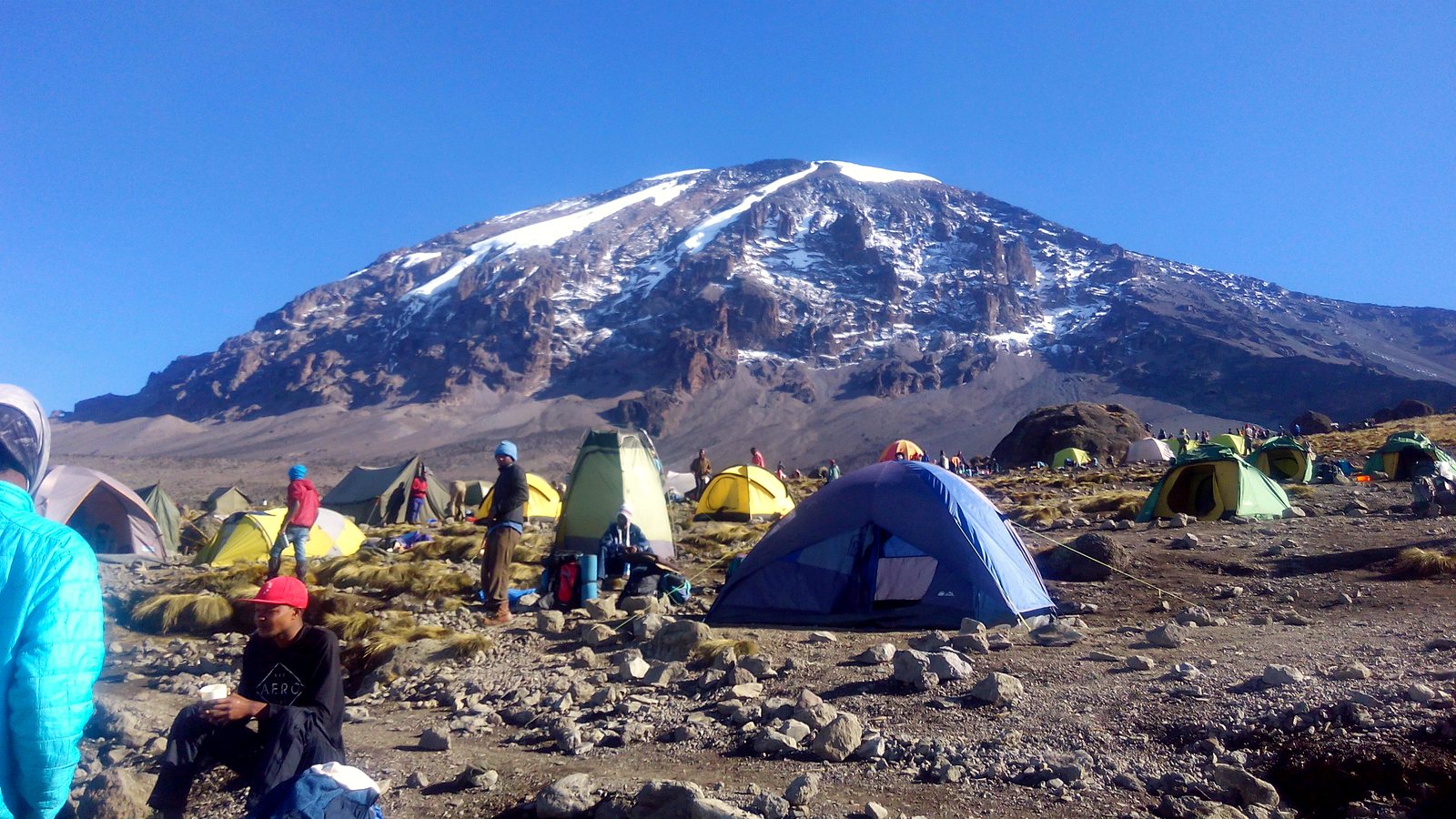
Varied climatic region and vegetation
Among the seven summits, none offers a wider variety of alpine landscapes than Mt Kilimanjaro. The mountain offers a tropical-to-arctic climatic landscape. These regions can be classified into 5 different zones:
- Cultivation zone (800 m – 1800 m). This is the lowest part of the mountain, mostly comprising farmland and a local village. You usually pass through this region when driving towards the base camp. Here, the climate is generally warm, like in the equatorial belt.
- Rainforest (1800 m – 2800 m). This is the first zone you will find as you start the trek. It mostly consists of tropical rainforest with dense indigenous trees and abundant flora and fauna.
- Heather and moorland zone (2800 m – 4000 m) – Here, the temperature fluctuates, especially at night. The region still has some adapted plants, mostly stunning moorlands.
- Alpine desert (4000 m- 5000 m). This is even colder, and here there is no plant life growing, apart from lichen, on the rocky landscape.
- Arctic region (5000 m – 5895 m ). This region experiences subzero temperatures, as in the polar regions. It is the summit and features a shimmering glacier, which is a remnant of the ice age.
The other seven summits do not offer this unique variation. For instance, Mount Everest and Aconcagua are significantly taller, but they do not offer the same variety. Because their base camps are already at high altitudes (above 5,000m for Everest), they lack the tropical and temperate zones found at the start of a Kilimanjaro trek. Conversely, mountains like Mount Vinson in Antarctica are entirely polar, with the entire mountain in a single polar climate from base to summit. The variations in Kilimanjaro evoke the true sense of adventure.
Kilimanjaro is the perfect balance, just under 6000 m a.s.l.
At 5,895 meters, Mount Kilimanjaro sits just under 6,000 meters. This matters more than it sounds. With that elevation, Kilimanjaro is a true altitude challenge, but also well manageable. Unlike on Everest, you don’t need supplemental oxygen, and you are at a lower risk of altitude-related complications than on other higher summits. In addition, while it’s cold at Uhuru Peak, it doesn’t reach the extreme levels at other peaks. This makes Kilimanjaro an ideal mountain for climbers making their first attempt at a high-altitude climb. However, make no mistake in thinking that Kilimanjaro is an easy climb. Many climbers still suffer from altitude sickness, and some even have severe cases, leading to an immediate descent before summiting. There are also a few incidents of fatalities that have been recorded. However, with proper acclimatization and following the right adaptation plan, you have an over 90% summit success rate.
Has a higher base to summit elevation than other mountains
Though it may not be the highest mountain among the Seven Summits, Kilimanjaro has the greatest elevation gain. This is because Mount Kilimanjaro is the highest freestanding mountain in the world. This means that the mountain is a standalone and doesn’t share a base with other mountains, unlike Everest, which is part of the Himalayas. Mountains like Everest are also elevated because they sit on a plateau, which puts them at a certain altitude.
| Mountain | Summit altitude ( m a.s.l) | Elevation gain (from base camp to peak in m) |
|---|---|---|
| Mt Everest | 8849 m | 3498 m |
| Aconcagua | 6961 m | 3962 m |
| Denali | 6190 m | 4000 m |
| Mt Kilimanjaro | 5895 m | about 4,000–4,300 m |
| Mt Elbrus | 5642 m | about 3,300 m |
| Vinson Massif | 4892 m | about 2,800 m |
| Carstensz Pyramid | 4884 m | Variable (technical climb) |
The elevation gain makes it the most worthwhile option if you want to test your resilience and the best mountain-climbing challenge to remember.
Kilimanjaro offers the best balance between cost and experience.
Due to its lower technical requirements, Kilimanjaro is probably the best if you are looking at cost versus value. On average, it costs between 2000 USD and 5000 USD to summit Kilimanjaro, depending on the budget category and the duration of the climb. This is way more affordable than Aconcagua (4000 USD – 8000 USD), Everest (40000 USD – 100000 USD), and Vinson (40000 USD+). The mountain also requires only protective gear for the hike, which can be rented from your operator at very affordable rates. This is the best offer you can get for such a high-altitude climb. The price in mt Kilimanjaro comes with
- Full support crew (guides, porters, cook)
- Transfers between Moshi and the park gates
- Sleeping and dining tent/ hut accommodation
- Meals on the mountain
- Park fees and logistics
- Structured itineraries for acclimatization
Experience beyond the summit
Kilimanjaro is in Tanzania, one of the world’s most popular safari destinations. The mountain in northern Tanzania has several iconic parks, including:
- Serengeti National Park. Serengeti is one of the oldest wildlife protection areas on the planet and is home to the great wildebeest migration, the largest terrestrial wildlife movement. Serengeti is also home to wildlife such as lions, elephants, buffalo, cheetahs, leopards, and giraffes.
- Ngorongoro Crater. This is the world’s widest crater that is still largely intact. The crater floor is home to one of the highest concentrations of wildlife in Africa, including lions, elephants, hippos, giraffes, buffaloes, and rhinos.
- Lake Manyara. Lake Manyara is Tanzania’s most famous lake park and one of the most rewarding birding destinations in East Africa. The park is also home to the famous tree-climbing lions.
- Arusha National Park. This is a small park on the foothills of Mt. Meru, one of the highest peaks in Tanzania and a popular hiking volcano, commonly referred to as ‘Kili little sister’. The park is also home to giraffes, buffaloes, zebras and colobus monkeys.
- Tarangire. Tarangire is a popular park known for its spectacular ancient baobab trees, some over 1000 years old. The park is also home to some of the largest elephant herds you will find on a safari.
Importantly, the parks are aligned so you can explore them together on a multiday round-trip starting in Arusha, the regional capital. Besides, you can opt to take a flight to Zanzibar, a popular beach island in Tanzania, for relaxation.
Conclusion
While Kilimanjaro isn’t the highest peak among the Seven Summits, it is undoubtedly the most rewarding, adventurous, and easiest of all. Mt Kilimanjaro is the least technical, sits just below the tough 6000 m a.s.l. mark, has the highest elevation gain, has the most unique landscape, and offers a more exciting experience beyond the hike.
Ready to climb Kilimanjaro? Explore our 7 day Machame Route climb, 7 day Marangu Route climb and 10 day Lemosho Route climb, or contact us and we will help you choose the right route and dates.