

The Masai Mara lies north of the Serengeti, across the border in Kenya. Together with the conservancies around it, the reserve forms the Greater Mara, which is home to a huge variety of wildlife and birds. The landscape is just as rewarding: open savannah plains, the wooded Oloololo (Siria) escarpment on the western edge, and riverine forest along the Mara River and its tributaries. Although the Masai Mara is much smaller than the Serengeti, it has a very high density of wildlife, which makes it one of the best places in Africa to see most of the big animals in a short time. The migration herds are in the Masai Mara from about mid-July to October.
Mara River crossings and the migration in the Greater Mara
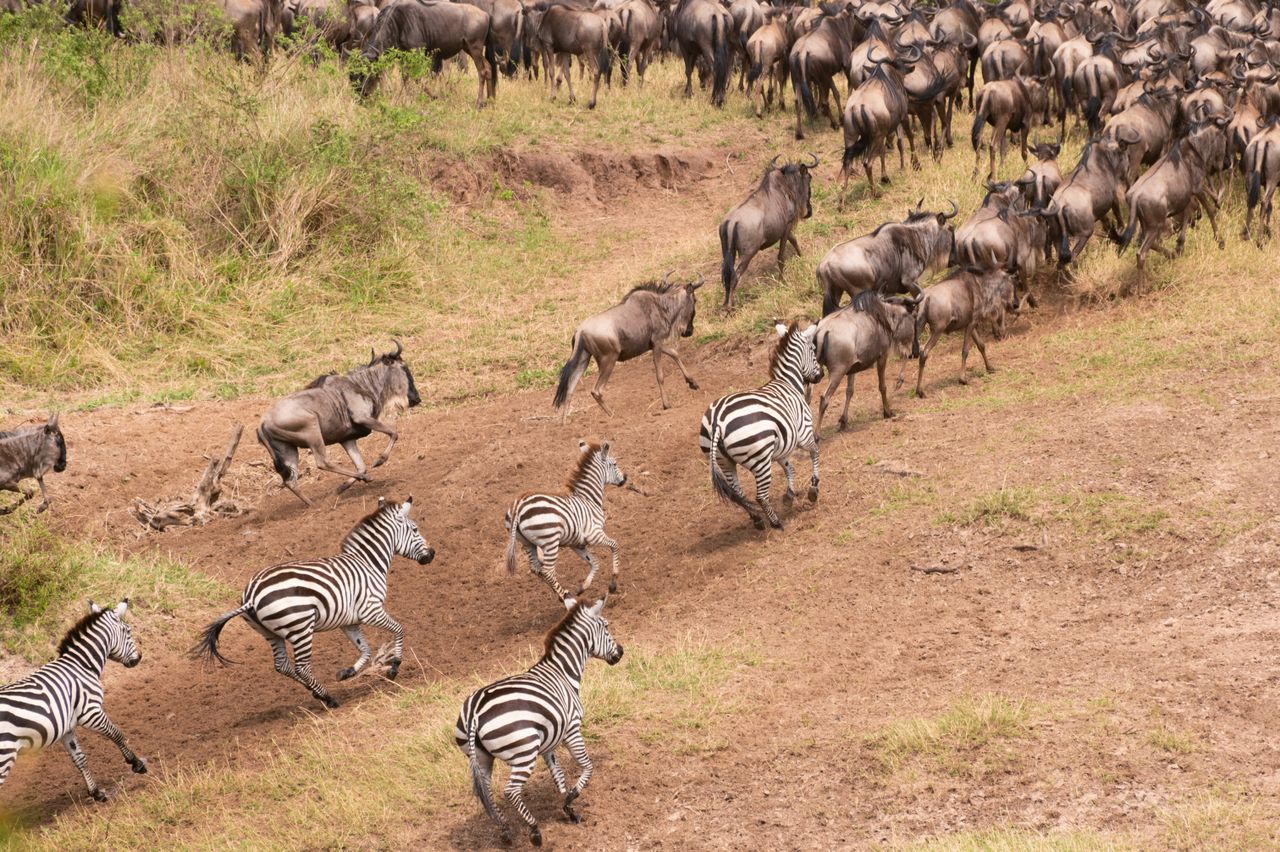
The migration usually reaches the Masai Mara in the second half of July (it can be a little earlier or later), when the first big herds move up from the northern Serengeti into the Mara Triangle and across the Mara River. The river crossings are the most sought-after moment of the whole cycle. Crocodiles wait in the water, the herds bunch nervously on the banks, and once the first animals jump, thousands follow in a rush to the far side. Sometimes the wildebeest make it across only to meet lions waiting in the bush and long grass along the river. The Greater Mara has some of the highest lion densities in Africa, and the reserve is roughly a tenth of the size of the Serengeti, so dramatic hunts are a common sight on game drives during the migration season. After crossing, the herds spread out over the plains of the reserve and into the conservancies to the north and east. They stay on the grassy Mara side of the ecosystem through to October, then head back south into the Serengeti through the Lobo area. Remember that the river crossings are not a single event: the herds cross back and forth, and crossings happen from July to October, usually best in August and September.
Where to stay in the Masai Mara
The Masai Mara has the widest choice of accommodation of all the regions on the migration route, from camps and lodges inside the reserve to those in the private conservancies around it. Most of the camps inside the reserve are set along the Mara River and its tributaries.
Top accommodation for a Masai Mara migration safari
Little Governors’ Camp
Category: Luxury
Good for: Couples, honeymooners, families with children
Little Governors’ Camp sits on the western bank of the Mara River and is reached by a short boat ride across the river. It is well placed for the river crossing points. The tents look out over a marsh and waterhole that attracts resident and migratory wildlife. The camp has 17 luxury tents, including a family tent.
Cottar’s camps
Category: Luxury
Good for: Couples, honeymooners, families with children, groups of families
Cottar’s has two properties, Cottar’s 1920s Safari Camp and Cottar’s Private Bush Villa, both in the Olderkesi Conservancy on the south-eastern edge of the reserve, next to the Serengeti border. This is a good place to be in September and October, when the herds start to head back to the Serengeti. Cottar’s 1920s Safari Camp has tents for couples, honeymooners and families with children, while the Private Bush Villa is rented on an exclusive basis, which suits a group of families. Guests can enjoy walking safaris, open-sided game drives and night game drives, which give an authentic, close-up experience of the migration herds.
Mara Ngenche
Category: Luxury
Good for: Couples
Mara Ngenche is a small camp on the Mara River in the heart of the reserve, close to crossing points on both the Mara and Talek rivers. The area is home to resident lion prides, and the riverine forest is known for good leopard sightings, which makes it one of the best areas to see a hunt. Each tent is set in its own private, secluded spot on the river, so guests enjoy real privacy and exclusivity.
Mara Serena Safari Lodge
Category: Standard
Good for: Solo travellers, couples, honeymooners, weddings, families with children
Mara Serena sits on a small hill above the Mara River inside the Mara Triangle, close to several of the crossing points on the Triangle side. From July to October the migration herds can spread across the plains around the hill, giving superb views right from the lodge. Mara Serena is well located for the migration and offers fair rates for its position. It has a wide choice of rooms, including spacious family suites.
Acacia House
Category: Luxury
Good for: Families with children
Acacia House is a home-style option in the Mara North Conservancy, where large numbers of migratory herds gather from August to October. Families here can enjoy the migration on private walking safaris, horseback safaris, night game drives and open game drives. What sets it apart is that the whole team, from the housekeepers to the chef, is dedicated to your group. Each house is in its own private compound with its own facilities.
FAQ
Is a Masai Mara migration safari good value?
The Masai Mara is the most budget-friendly part of the Mara–Serengeti ecosystem, and you can plan a migration safari here at almost any budget. As well as the luxury and standard camps inside the reserve and the conservancies, there are budget camps near the main gates with very friendly rates, and several public and private campsites for backpackers.
Why should I go on a migration safari in the Masai Mara?
The stretch of the Mara River in the south-west of the reserve has some of the most reliable river crossing points. Besides the crossings, the Greater Mara has a very high lion density, so there are plenty of exciting hunts on the plains. The conservancies to the north and east offer some of the most rewarding migration activities, such as walking safaris and night drives. On top of this, the Masai Mara’s wide range of camps and lodges gives you plenty of family-friendly choices at every budget.
What is the weather like during the Masai Mara migration season?
The migration is in the Masai Mara from about July to October, which is the long dry season. There is little rain at this time, although an occasional shower is possible. Game viewing is excellent because the herds and other wildlife gather on the grassy plains along the Mara River and its tributaries.
Which other places can I visit on a Masai Mara migration safari?
A Masai Mara safari is easy to combine with some of Kenya’s leading safari destinations. Lake Nakuru, Lake Naivasha, Hell’s Gate, Nairobi and Amboseli are the closest and most popular choices on a road safari. On a longer trip you can also add the Aberdares, Lewa, Samburu and Ol Pejeta.
Ready to see the migration? Join our 5 Day Wildebeest Migration Safari in the Masai Mara for the river crossings from July to October, or combine Kenya and Tanzania on our 6 Day Masai Mara, Serengeti and Ngorongoro Safari. Contact us and we will plan the right migration safari for your dates and budget.