

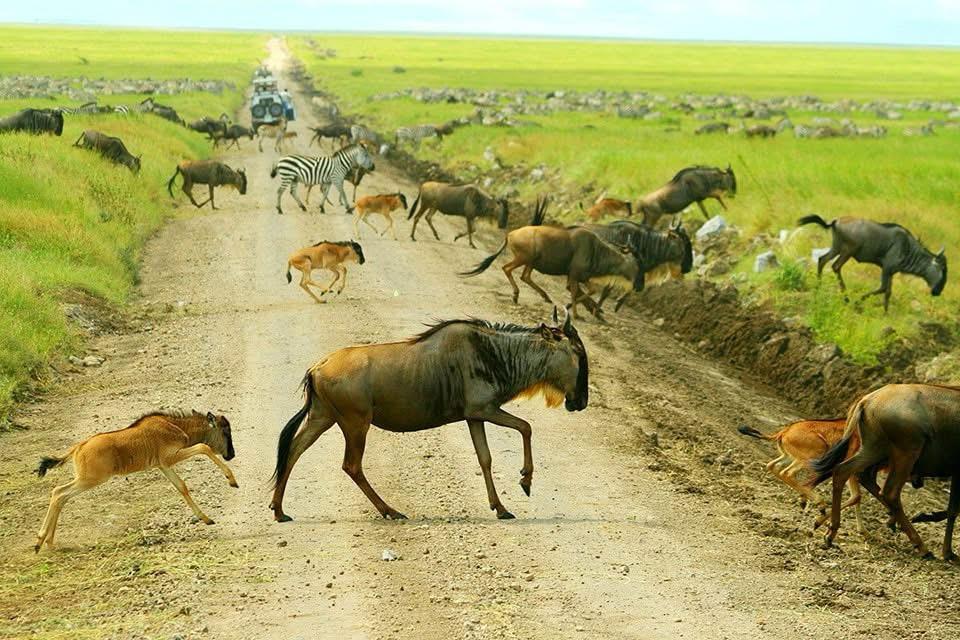
The central Serengeti is the busiest part of the park. This is because it is central to the other regions and has the best tourist infrastructure, and it also has a very high density of resident wildlife. The Seronera valley, which lies between the southern short-grass plains and the northern woodlands, is excellent for birding, with a wide range of species. The valley is also a key game area, famous for its big cats, especially lions and leopards. Resident herds of wildebeest and zebra can be seen in several parts of the Serengeti all year, and the migration passes through the central Serengeti twice: on its way north from about April to June, and on its way south from about October to November.
The migration through the central Serengeti, northbound and southbound
Northbound migration
In April, after calving, the herds leave the southern Ndutu plains and move north-west into the Moru and Simba kopjes area of the southern-central Serengeti. The long rains leave plenty of grass, so the herds spread out: some head west into the western corridor, while others move north through the central region. Soon the herds reach the Seronera valley, often moving in their famous columns that can stretch for kilometres. The acacia-dotted valley is home to all three of Africa’s big cats, cheetahs, lions and leopards, so the predator action is excellent. The herds move through the central area from about April to June before heading on to the western corridor and the north. The area around Serengeti Serena Safari Lodge, towards the western corridor, is one of the best places in the central region to watch the northbound movement.
Southbound migration
When the herds leave the Masai Mara in October, they cross back into the northern Serengeti and head south, mostly through the Lobo area and down the eastern side of the park. Other groups come south from Lamai and Kogatende in the north-west. The herds pass through the Seronera area and the plains to the east of it from about October to November, and then continue to the southern plains around Ndutu in late November and December for the calving season.
Where to stay in the central Serengeti
The central Serengeti has the widest choice of accommodation at every budget level. Unlike in the other regions, most camps and lodges here are permanent and open all year.
Top accommodation for a central Serengeti migration safari
Four Seasons Safari Lodge Serengeti
Category: Luxury
Good for: Couples, families with children, groups of families or friends
Four Seasons Safari Lodge is a large luxury lodge in the heart of the Serengeti National Park. It overlooks a waterhole that draws elephants and other animals, with grassy plains and rocky outcrops around it. The migration passes through this central area on its way north and again on its way south, and the Seronera area has one of the highest big cat populations in Africa, so it is a good base for guests hoping to see predator action. Because the lodge is inside the national park, activities are mainly game drives. It has a wide choice of rooms, suites and villas, including large villas for families and groups of friends.
Dunia Camp
Category: Luxury
Good for: Couples, honeymooners, families with children (5 years and above), groups of families
Dunia Camp is in the south-central Serengeti near the Moru kopjes. It is the place to be in April and May, as the herds leave the southern plains after calving, and again in November and December, when they come back south. This makes it the best choice for a combined central and southern Serengeti migration safari. The lions of the Moru and Simba kopjes area are sometimes seen hunting near the camp, so it is a good choice for guests hoping to see a hunt. With just 8 tents, Dunia is ideal for a group of friends who want a camp to themselves. One tent has a family layout for a family with children.
Kati Kati Tented Camp
Category: Budget
Good for: Solo travellers, couples, families with children
Kati Kati Tented Camp is set on the grassy plains of the Seronera area. It is well placed for game drives in the Seronera valley and towards the western Serengeti, and for seeing the migration as it passes through the central region. With 10 tents and a family tent, Kati Kati is one of the most affordable options in the central Serengeti for all kinds of travellers.
Roving Bushtops
Category: Luxury
Good for: Couples, families with children, groups of families or friends
Roving Bushtops is in the heart of the Seronera area in the central Serengeti. The camp is set on a gentle slope among beautiful acacia woodland, with great views over the endless grasslands. The migration passes through on its way north from about April to June and on its way south from about October to November, and the Seronera area has a high lion density, so seeing a hunt on your game drive is quite common. With just 8 tents, Roving Bushtops is a great choice for a group that wants the whole camp. One tent is a family tent for up to six guests.
Ole Serai Camp
Category: Standard
Good for: Couples, honeymooners
Ole Serai sits on the Makoma hills, overlooking the wildlife-rich Makoma plains in the central Serengeti. The herds pass through on their way north and again on their way south, before they return to the southern plains for the calving season. The Makoma plains have a good number of cheetahs, and a lion pride lives around the kopjes, which makes this a good choice for guests hoping to see a hunt. Ole Serai has 9 tents, each designed for privacy. There is no family tent, but the tents are spacious enough for an extra single bed for a child.
FAQ
Is a central Serengeti migration safari good value?
The central Serengeti has the widest choice of budget accommodation in the park, which makes it the best choice for a budget-friendly migration safari in Tanzania. Most of the Serengeti’s public campsites are also here, making it ideal for a camping safari.
Why should I go on a migration safari in the central Serengeti?
The central Serengeti sees the migration twice: on its way north from about April to June, and on its way south from about October to November. The Seronera valley also offers some of the best chances of seeing predator action in the Serengeti.
What is the weather like during the central Serengeti migration season?
The northbound migration passes through during the long rains of April and May and into the dry month of June. April and May are green and quiet, with fewer visitors and lower rates. The southbound herds pass through at the end of the dry season and the start of the short rains in October and November. Game viewing is rewarding in both seasons, as the herds gather wherever there is fresh grass.
Which other places can I visit on a central Serengeti migration safari?
From the central Serengeti you can easily reach the other regions of the park for game drives. The Ngorongoro Crater, one of Tanzania’s leading safari destinations, is about 3 to 4 hours’ drive away.
Ready to see the migration in the Serengeti? Explore our 7 Day Best of Tanzania Safari, or combine Kenya and Tanzania on our 6 Day Masai Mara, Serengeti and Ngorongoro Safari. Contact us and we will plan the right migration safari for your dates and budget.