

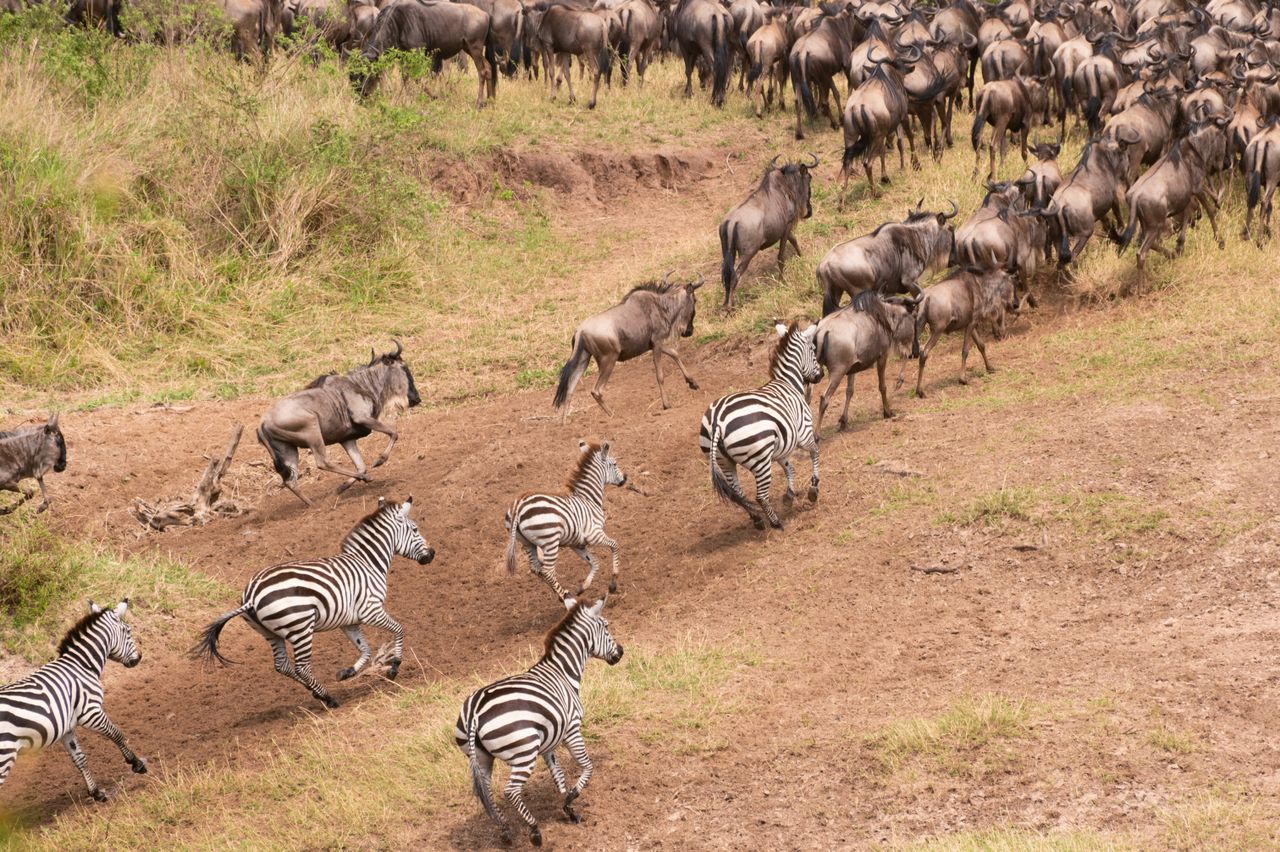
The Mara River is the biggest obstacle the herds face during the migration. It rises in the Mau escarpment, enters the Mara–Serengeti ecosystem in the north-west of the Greater Mara, flows through the Masai Mara and the north-western Serengeti, and then on to Lake Victoria. As it winds through the Masai Mara and along the south-western edge of the Mara North Conservancy, the river cuts off a small part of the ecosystem on its western bank, less than a tenth of the whole: the Lamai triangle on the Serengeti side and the Mara Triangle on the Masai Mara side. This wedge has excellent grazing all year round, and it is well watered by springs and floodplains. During the northern migration, the herds, whose movement depends entirely on the grazing, keep crossing between the wedge and the larger wilderness to the east, depending on where the grass is better. Unlike the other rivers on the migration route, the Mara River is a real challenge, as the herds have to get past large crocodiles in the water and lions waiting in the long grass on the banks. Still, they keep crossing in search of fresh grazing as more and more herds build up in one area. Throughout the crossing season, from July to October, there are crossings on most days somewhere along the river. Some involve huge herds and go on for hours, while others involve a small group and last only a few minutes. In this guide we share details of the major crossing points and what each one offers.
The major Mara River crossing points
There are around 20 crossing points along the Mara River in the Masai Mara and the Serengeti, and more than half of them are on the Serengeti side. The northernmost major crossing point is Kichwa Tembo, near the Mara North Conservancy, and the southernmost is crossing point 0, in the west of the northern Serengeti.
Crossing points on the Serengeti side
Crossing points 0, 1, 2 and 3
Crossing points 0, 1, 2 and 3 are the best place to follow the crossings early in the season. Apart from crossing point 0, which is further west, crossing points 1, 2 and 3, and the less reliable but scenic crossing point 2A (between 2 and 3), are close together, so you can easily follow them all. Crossing point 0 is the most underrated, with few visitors, but it is the most convenient for travellers coming from the western Serengeti. The river here is rocky, so as well as the crocodiles, many animals are lost to injuries in the stampede.
Crossing point 4
Crossing point 4 lies on a sharp bend north of crossing point 3. It is less rocky than the crossing points downstream, and its fairly deep water is home to one of the largest numbers of Nile crocodiles on the river, so it often has very dramatic scenes. A resident lion pride in the area adds to the tension.
Crossing points 5 and 6
Crossing points 5 and 6 are in Kogatende, the hub of the northern Serengeti. Here the banks are steep and rocky, which leads to deadly stampedes, as at the crossing points downstream. Crossing point 5 in particular gives you one of the best chances of seeing crocodiles in action, as it is home to a large number of them.
Crossing points 7A and 7B
These two crossing points are very close together, separated only by a creek. They are popular with herds heading both north and south, and you have good chances of seeing crossings here from July to October. This stretch of the river is fairly deep, with no hippo pools nearby, and it has a large crocodile population, which makes it a great choice if you hope to see crocodiles hunting.
Makutano crossing point
Makutano sits where the Mara River meets the seasonal Bologonja River, and it is the most dramatic crossing point on the Serengeti side. It is popular with herds heading both north and south, with crossings from July to October. Makutano has the steepest banks and the best viewpoints, with more space for vehicles than the crossing points downstream, which makes it a top choice for migration photographers.
Crossing points 8 and 9
Crossing points 8 and 9 are on a rocky stretch of the river just north of Makutano. Few visitors focus on these two points, so they offer a quieter but still rewarding crossing experience. The crossings here usually start in July, when the herds gather in the area, which stretches up towards Lemala Kuria Hills.
Crossing point 10
Crossing point 10 is the most underrated crossing point upstream on the Serengeti side. It lies just south of where the Sand River joins the Mara River, and it is the closest crossing point to the Kenyan border. There are no rocks here, but the water is deep, so most deaths here are caused by crocodiles. The banks have a gentle slope, like those at crossing point 4 and Makutano. From here you can also reach the Sand River crossing point near the confluence.
Crossing points in the Masai Mara
Lookout crossing point
Lookout is the southernmost crossing point in the Masai Mara, near the Tanzanian border. It is popular with herds crossing from the Mara Triangle into the main reserve, and it often has some of the earliest crossings in the Masai Mara, from about mid-July. The crossing point is on a sharp bend at the foot of Lookout Hill, on the Mara Triangle side of the river. The water here is deep and home to some very large Nile crocodiles. Just downstream is the less well-known Miti Moja crossing point.
Olarro crossing point
Olarro is another major crossing point in the Greater Mara. It lies on a bend of the river just south of where the Talek River joins the Mara River. It is about 20 minutes from the Serena crossing point and 15 minutes from Lookout, so it is easy to follow all three together. Because it is close to the big cat territories around the Mara–Talek confluence, crossings here often lead to exciting hunts on land.
Serena crossing point
The Serena crossing point, also known as the Main Crossing, is on a bend of the river near Mara Serena Safari Lodge. It has few rocks and a gentle slope, and huge herds cross here in both directions, to and from the Mara Triangle. This stretch of the river is home to many Nile crocodiles, so you have a good chance of seeing a hunt. Together with Kaburu, just to the north, it is one of the busiest crossing points in the Masai Mara.
Kaburu crossing point
Kaburu is about 15 minutes from the Serena crossing point and is the toughest crossing point in the Masai Mara. The river here is deep, which lets the crocodiles stalk the herds unseen. Kaburu is also within the range of the Marsh pride and the Kaburu pride, so hunts on the riverbanks are common.
Kichwa Tembo crossing point
Kichwa Tembo is the northernmost crossing point on the Mara River. It has beautiful sloping banks and fairly deep water. It is the closest crossing point to the Oloololo escarpment, the Mara North Conservancy and the Kichwa Tembo concession. It is popular with herds heading north from the Mara Triangle towards Mara North, and the main lion pride here is the Rongai pride.
Ready to see the migration? Join our 5 Day Wildebeest Migration Safari in the Masai Mara for the river crossings from July to October, or combine Kenya and Tanzania on our 6 Day Masai Mara, Serengeti and Ngorongoro Safari. Read next: Northern Serengeti Migration in Detail. Contact us and we will plan the right migration safari for your dates and budget.