

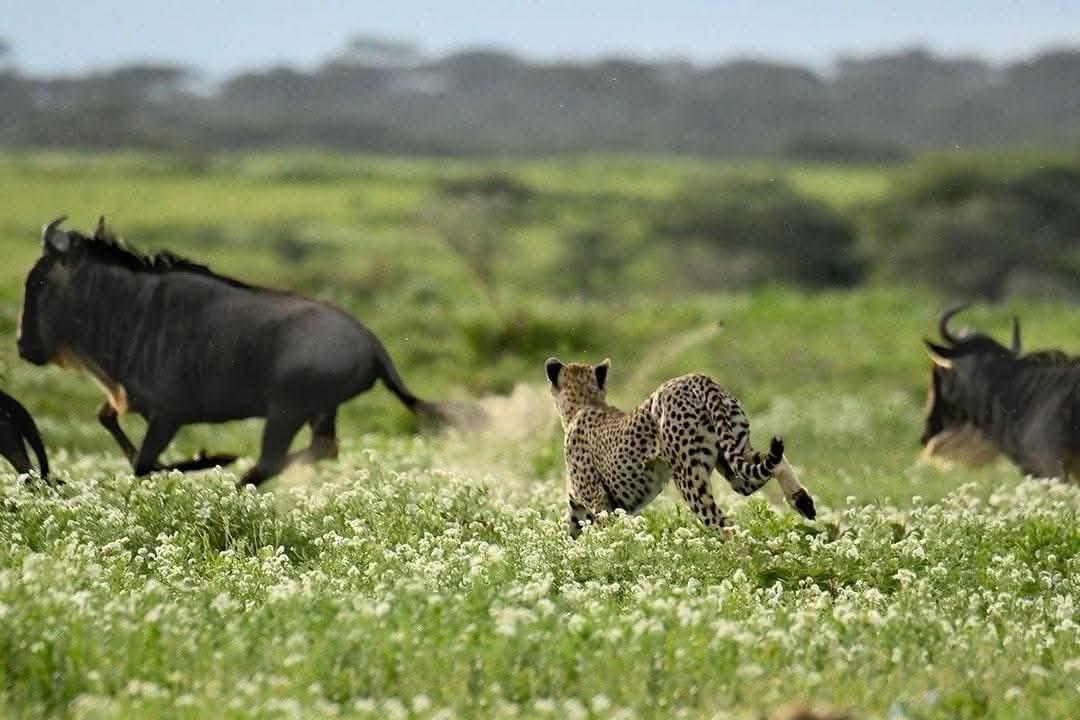
The eastern Serengeti is mostly open grassland, home to a wide variety of African animals. It is one of the least visited parts of the Serengeti National Park, and you may not see another safari vehicle on your game drives, especially towards the north-east. Although it has fewer famous landmarks than other parts of the park, guests here enjoy wonderful views of rocky outcrops (kopjes) and the lone Lemuta hills. The region is well known for its cheetahs, especially around the Gol kopjes. Thanks to its wide grasslands, the eastern Serengeti is rich in grazers such as eland, Thomson’s gazelles and buffalo, with hippos in the marshes. It also has good numbers of lions and the elusive leopard, especially around the Gol kopjes.
The southbound migration
In October the herds leave the Masai Mara and head south into the northern Serengeti, while other large groups come south from the Lamai and Kogatende area. Many of the herds come down through the Lobo area in the north-east, which is also a good area for walking safaris on its eastern edge. By late October and November the herds are passing the Sametu marshes and on towards Nasera Rock. A resident lion pride lives here, which makes this one of the best times to see hunts for guests staying at Sametu Camp. Further south the herds reach the Gol mountains and the Lemuta hills. The granite outcrops here are perfect habitat for big cats, and the hunting action is at its best on this part of the route. From here the herds move into the wildlife-rich plains to the south, reaching the southern Serengeti around Ndutu from late November and December, ready for the calving season from January to March.
Where to stay in the eastern Serengeti
The eastern Serengeti has the fewest accommodation options in the park, and many of them are luxury camps. However, the region is close to the Seronera area, so you can also explore it from camps on the eastern side of the central Serengeti.
Top accommodation for an eastern Serengeti migration safari
Taasa Lodge
Category: Luxury
Good for: Solo travellers, couples, families with children
Taasa Lodge is set in a private area on the north-eastern edge of the Serengeti. It is a good place to stay in October and November, when the herds are moving south from the Masai Mara and the northern Serengeti. The lodge has a wide choice of rooms in lodge and tented style, from singles and doubles to spacious triples and quads that are ideal for families. Taasa stands out in the eastern Serengeti because you can go on walking safaris for a closer, more detailed encounter with the herds, and on night game drives when the big cats are out hunting. The lodge also has activities for children to keep them busy during their stay.
Lemala Nanyukie
Category: Luxury
Good for: Couples, honeymooners, families with children
Lemala Nanyukie is on the eastern edge of the Seronera area. Set in acacia woodland, it has a real bush feel. The herds pass near the camp from about October to December. The camp has 15 luxury tents, including a two-bedroom family tent, and each tent has its own private deck. It is ideal for guests who want to combine game drives in the eastern Serengeti with the southern or central Serengeti.
Sametu Camp
Category: Luxury
Good for: Couples, families with children
Sametu Camp is on the grassy plains on the eastern side of the central Serengeti. It is well placed for a migration safari in October and November, when large herds can gather around the camp. The camp stands out for its exclusive feel, with just 8 tents and 2 family suites. Each tent has a private veranda with wide views of the surrounding plains. From here you can go on migration game drives in the eastern, southern and central Serengeti.
Klein’s Camp
Category: Luxury
Good for: Solo travellers, couples, families with children
Klein’s Camp is on the Kuka hills in the north-eastern Serengeti, overlooking the Grumeti River valley. It has a private concession of about 10,000 hectares just outside the national park, home to a wide variety of resident wildlife all year round. The herds pass through this area on their way north and again in October and November on their way south. Guests at Klein’s enjoy open-sided game drives in the concession and walking safaris for a closer, more authentic encounter with the herds. The camp has a choice of tents and cottages, including a separate family cottage.
Namiri Plains
Category: Luxury
Good for: Couples, honeymooners, families with children (5 years and above)
Namiri Plains is one of the most remote camps in the eastern Serengeti, about an hour’s drive from the nearest camp. It is set in the middle of big cat territory, especially for cheetahs and lions, which makes it a great base for a migration safari. The herds pass through here mainly in October and November on their way south. The camp has just 10 tents, one of which is a family tent.
FAQ
Is an eastern Serengeti migration safari good value?
The eastern Serengeti mainly has luxury accommodation, so it best suits travellers on a luxury safari. However, guests in budget and standard camps on the eastern side of the Seronera area can easily go on game drives into the region. The Lobo campsite in the north-east is the nearest public campsite for those on a camping safari.
Why should I go on a migration safari in the eastern Serengeti?
Because there are so few camps, the eastern Serengeti offers one of the most exclusive safari experiences, and few visitors reach its south-eastern and north-eastern corners. It also has good numbers of lions and cheetahs, so the migration brings exciting predator action.
What is the weather like during the eastern Serengeti migration season?
The migration passes through the eastern Serengeti from about October (in the north-east) to December (in the south-east). October is usually dry. November and early December are the short rains, but the rain usually comes as short showers, often in the afternoon or at night, rather than all day. Most of the region is open grassland, so game viewing stays good even in the rainy season.
Which other places can I visit on an eastern Serengeti migration safari?
From the eastern Serengeti you can visit Lake Natron, which is roughly 4 hours away. The lake is the most important breeding ground in the world for lesser flamingos. Next to the lake rises Ol Doinyo Lengai, an active volcano and the only one in the world known to erupt natrocarbonatite lava. You can also combine the eastern Serengeti with a safari in the Ngorongoro Conservation Area.
Ready to see the migration in the Serengeti? Explore our 7 Day Best of Tanzania Safari, or combine Kenya and Tanzania on our 6 Day Masai Mara, Serengeti and Ngorongoro Safari. Contact us and we will plan the right migration safari for your dates and budget.