

The Lamai triangle and the Mara Triangle together form a wedge of land west of the Mara River, separated from the rest of the Mara–Serengeti ecosystem by the river. The Kenyan part of the wedge is the Mara Triangle, and the Tanzanian part is the Lamai triangle. The two have more in common than not: they are one continuous wilderness with the same wildlife. However, you can’t easily combine both on one safari, because they are in two different countries, and crossing the border inside the wedge is not allowed and can lead to a fine. That is why it is worth thinking carefully about which triangle suits you best. In this guide we look at the differences between the two.
Which is bigger?
The Mara Triangle is the larger of the two, at about 510 square kilometres (about 197 square miles), compared with roughly 400 square kilometres (about 155 square miles) for the Lamai triangle. Both still give you plenty of wilderness to explore, and from the Lamai triangle you can also drive across the bridge into the wider Kogatende area of the northern Serengeti.
Which has more flexible rules?
The Mara Triangle has slightly more flexible rules than the Lamai triangle. In the Lamai triangle, off-road driving is not allowed. In the Mara Triangle, off-road driving is allowed in some areas, with a maximum of five vehicles at a sighting. This can make a real difference when the action is away from the main tracks.
Which is more exclusive?
The Lamai triangle is more exclusive. Both triangles are quieter than most other parts of the Mara–Serengeti, but the Mara Triangle sees more vehicles than Lamai. The Lamai triangle has only a handful of camps, such as Singita Mara River Tented Camp and Serian Serengeti, while the Mara Triangle has Mara Serena Safari Lodge, Little Governors’ Camp and camps along the Oloololo escarpment, and it is also visited on game drives by guests staying outside the Oloololo gate. The Lamai triangle, on the other hand, is reached only by a bridge from the Kogatende area, and many visitors in Kogatende don’t cross over, preferring to stay on the eastern side of the river and in the Lobo valley.
Where will I see the river crossings?
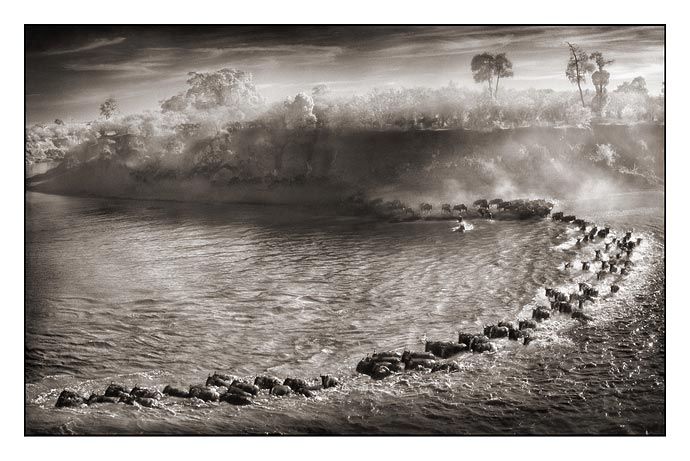
Both are excellent for the river crossings. In both the Lamai triangle and the Mara Triangle, the crossings take place from July to October and are usually best in August and September, with the herds crossing back and forth between the wedge and the larger wilderness to the east. The Lamai and Kogatende stretch has more crossing points and is usually quieter, while the Mara Triangle side is easier to reach, with more camps and lodges close to the main crossing points, such as the Serena and Kaburu crossings.
Where will I see lions hunting?
The Mara Triangle has a higher lion density than the Lamai triangle, so you have slightly better chances of seeing a hunt on the plains. Both triangles have good numbers of big cats, mostly lions and some cheetahs. The lions’ territories cross between the two triangles, and there have been cases of male lions crossing over to take over prides on the other side. Some of the best-known prides are the Lamai pride on the Tanzanian side and the Mugoro and Oloololo prides on the Kenyan side.
Where will I see more wildlife?
The Mara Triangle has a slightly higher wildlife density than the Lamai triangle, and the game viewing in the surrounding areas is also better. Both have the same wildlife, as they are part of one unbroken wilderness, and the wedge as a whole has more wildlife than many other areas, because the Mara River keeps many resident animals on the western side. The Mara Triangle’s wildlife is supported by the marshes along the Mara River, and the nearby Musiara area and the Mara–Talek area of the main reserve also have more wildlife than Kogatende and the Lobo valley.
Where can I go ballooning?
The Mara Triangle is better for a balloon safari. Apart from game drives, balloon flights are the main activity in both triangles. There is no balloon operator inside the Lamai triangle, so guests there fly over the Kogatende area or the Lobo valley instead. In the Mara Triangle, balloons drift along the Mara River, giving excellent views over the wedge, and there are more balloon operators in the main reserve, around the Mara–Talek area.
Which is better for families?
The Mara Triangle is the better choice for families. Mara Serena Safari Lodge has family units and is a good base for families, and there are more family options nearby, along the Oloololo escarpment and in the Musiara area. In the Lamai triangle, some camps have a minimum age, and there are fewer family options around Kogatende.
Which is more affordable?
The Mara Triangle is more budget-friendly. There are no public campsites in the Lamai triangle, while the Mara Triangle has several public and private campsites, which suits travellers looking for simple, low-cost accommodation. Even for luxury stays, the Mara Triangle has more affordable options, and Mara Serena Safari Lodge is one of the best-value places to stay inside either triangle.
Conclusion
Both the Lamai triangle and the Mara Triangle have their strengths, and the best choice depends on what you want from your safari. The Mara Triangle is slightly better for cost, families, lion hunts and overall wildlife density, and it is easier to reach. The Lamai triangle is better for exclusivity and fewer vehicles, with plenty of crossing points along the river. For the river crossings, both are excellent from July to October.
Ready to see the migration? Join our 5 Day Wildebeest Migration Safari in the Masai Mara for the river crossings from July to October, or combine Kenya and Tanzania on our 6 Day Masai Mara, Serengeti and Ngorongoro Safari. Read next: Where to Go for the Migration: Masai Mara vs Serengeti. Contact us and we will plan the right migration safari for your dates and budget.