

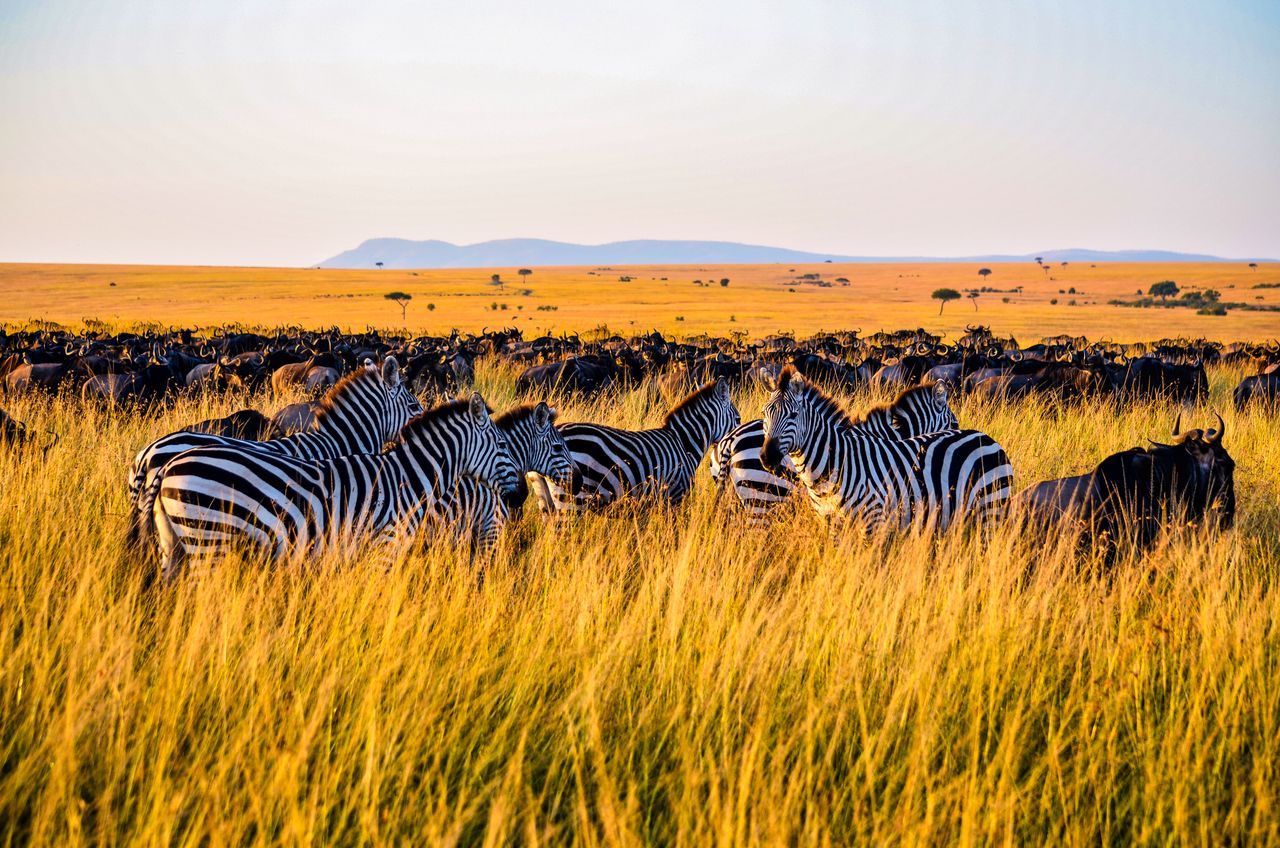
The Great Migration is one of the world’s greatest animal movements, with about 1.5 million wildebeest and hundreds of thousands of other grazers on the move. The herds take about a year to complete one cycle, moving around a loop of roughly 1,000 km. Along the way they have to cross rivers and river valleys that are home to some of the most powerful lion prides, crocodiles and other predators. In this guide we look at ten of the rivers the herds cross during the migration.
Mara River
The Mara River is the biggest obstacle the herds face during the migration. It rises in the Mau escarpment, flows through the Greater Mara and on through the northern Serengeti, and it is the only permanent river that supports the whole Mara–Serengeti ecosystem. Its basin, with rich riverbanks and oxbow floodplains, supports a wide variety of wildlife and birds. During the migration, the herds keep crossing back and forth between the larger eastern side of the river and the smaller wedge to the west, where they have to deal with the large Nile crocodiles that live in the river. Others break their legs as they plunge down the steep banks or get trapped between the rocks in the river, where they die and are swept away. The banks of the Mara River are also home to some of the largest lion prides in the ecosystem. The Mara River crossings take place from July to October and are usually best in August and September.
Grumeti River
The Grumeti River is the second most dangerous river the herds cross. It flows from the east of the Serengeti to the west and is home to large Nile crocodiles that wait for the herds at the crossing points. The Grumeti River crossings usually take place from June to early July. Unlike the Mara River, where the herds cross back and forth many times, most of the herds cross the Grumeti only once or twice, because the river lies across their path. As on the Mara River, they cross at points they see as less dangerous, where the water is shallower.
Sand River
The Sand River is a seasonal river whose course runs along the Kenya–Tanzania border before it joins the Mara River. Some travel websites mistake it for the Mara River. It has a popular crossing point near the Mara River crossing point 10. Crossings here are not as dramatic as on the Mara River, because the water is shallow and the herds can walk across with ease.
Talek River
The Talek River is the largest tributary of the Mara River in the Greater Mara. It flows from the Loita hills in the north-east and grows larger as it is joined by its main tributary, the Olare Orok, and by streams from the hills in the north of the reserve. The Talek has rich riverine woodland and grassy plains. Its best-known crossing point is near Rekero Camp, where the river is shallow and rocky and the herds cross through pools of water. A Talek crossing can go on for several hours, especially when the herds are moving south. Although it is not as dramatic as the Mara or Grumeti crossings, the Talek valley is home to some of the highest numbers of big cats in the ecosystem, so you are likely to see hunts along this stretch. The area where the Talek meets the Mara River is especially rich in big cats.
Olare Orok River
The Olare Orok is the largest river in the northern part of the Greater Mara after the Mara River itself. It flows through the Mara North and Olare Motorogi conservancies and is home to a good number of hippos. Its thick riverine forest is also home to big cats, mostly leopards and lions. Although the crossings here are not dramatic, some of the Serengeti herds cross it as they move from the north-west of the Greater Mara to the south-east. The Loita herds, whose route covers much of this area, cross it several times as they move through Mara North and Olare Motorogi. The Olare Orok is the main tributary of the Talek River.
Ntiakitiak River
The Ntiakitiak is the main tributary of the Olare Orok. This small river rises in the Olare Motorogi Conservancy, and its thick riverine forest is home to a wide variety of birds and wildlife. The valley is the territory of the Ntiakitiak pride, one of the main lion prides in the area. There are no dramatic crossings here, but the hunting scenes are impressive.
Seronera River
The Seronera River is one of the most important water courses on the migration route. It runs through the central Serengeti and forms the Seronera valley, an outstanding riverine area with some of the richest vegetation in the Serengeti. There are no crocodile-filled crossings here, but the Seronera valley has one of the highest concentrations of big cats in the Serengeti, and hunts on the plains are common. The valley also has some of the best accommodation in the central Serengeti, with views of the migration stretching as far as the Moru kopjes.
Mbalageti River
The Mbalageti is one of the longest rivers in the Serengeti, flowing from the south-east to the west. The herds cross the Mbalageti valley at least twice in every cycle, once on the way north and once on the way south. The valley marks the change from the mostly open savannah of the south to the more wooded country further north, and it is home to a wide variety of wildlife and birds.
Ngare Nanyuki River
The Ngare Nanyuki is one of the rivers that feed the Grumeti, flowing through the eastern Serengeti. Its valley is one of the richest wildlife corridors in the park, with grassy plains all year round, and it has some well-known camps nearby, such as Lemala Nanyukie. There are no dramatic crossings here, but the hunting on the plains is excellent, as the valley is home to one of the biggest lion prides in the Serengeti.
Mbono River
This seasonal river flows from the Serengeti into the Maswa area, where it joins the Simiyu River on its way to Lake Victoria. It supports the wildlife of the Maswa region, and its acacia-lined banks offer grazing through the dry months. The herds cross the Mbono valley during the calving season, from about December to March. Many of the area’s resident big cats live along this valley, making it one of the best places to see hunts in the area.
Ready to see the migration? Join our 5 Day Wildebeest Migration Safari in the Masai Mara for the river crossings from July to October, or combine Kenya and Tanzania on our 6 Day Masai Mara, Serengeti and Ngorongoro Safari. Read next: 10+ Interesting Facts About Wildebeest (Gnus). Contact us and we will plan the right migration safari for your dates and budget.