
The southern Serengeti takes in the southern part of Serengeti National Park, the Ndutu area of the Ngorongoro Conservation Area and the Maswa Game Reserve. The southern short-grass plains are mostly open and treeless, while the area around Lake Ndutu and Lake Masek has beautiful umbrella acacia woodland. The region is also home to plenty of resident wildlife, including lions, cheetahs, leopards, hyenas, zebras and baboons. The migration herds start arriving here from late November and December, coming down from the north and east after the short rains. The rains bring fresh grass, enough to carry the herds through the calving season, and the grass on these volcanic plains is rich in phosphorus and nitrogen, which is good for nursing mothers.
Calving
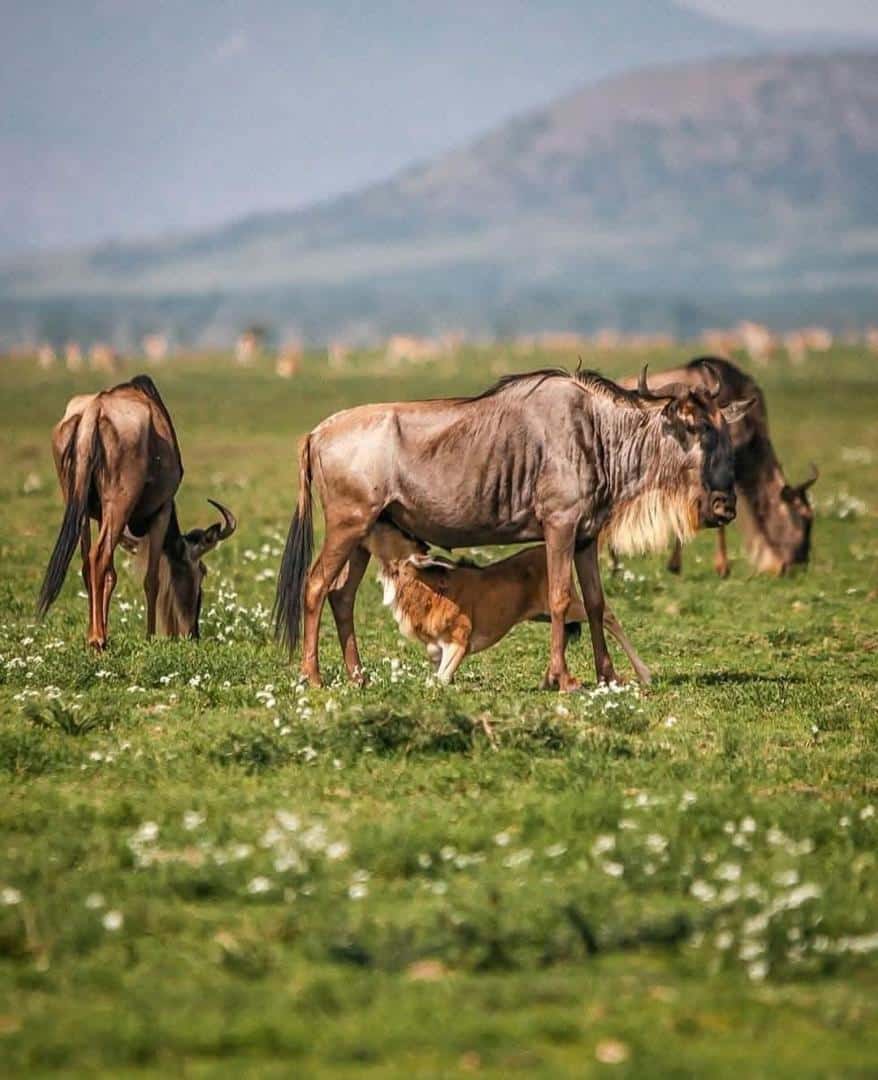
Calving starts slowly in January, when a few females begin to drop their calves. January is often fairly dry, but there is still plenty of grass from the short rains. The number of births keeps rising through January as more herds arrive in the south. By February most of the calving herds are on the southern plains, and the sight of the massive herds is unforgettable. February is the peak of the season, and for two to three weeks there are about 8,000 births a day.
All these births bring plenty of predator action. On a migration safari in February you are likely to see lions, cheetahs and spotted hyenas stalking the herds, hoping to take a weak newborn from its mother. The tension is real and the chances of seeing a hunt are high. To protect the newborns, the females push the calves to the centre of the herd. A newborn wildebeest can walk within minutes of birth, although it is still wobbly. The grassy plains around Lake Ndutu and Lake Masek in the Ngorongoro Conservation Area are the best places to see the herds during this season. Calving winds down in March, and as the long rains arrive the herds start to move north-west, towards the central Serengeti and the western corridor, in April and May.
Where to stay in the southern Serengeti
Several of the camps in the southern Serengeti are seasonal mobile migration camps. Many travellers prefer to stay in the Ndutu area of the Ngorongoro Conservation Area, which gives easy access to both the southern Serengeti plains and the Ngorongoro Crater.
Top accommodation for a southern Serengeti migration safari
Ndutu Safari Lodge
Category: Standard
Good for: Couples, families with children, solo travellers
Ndutu Safari Lodge is in the Ngorongoro Conservation Area near Lake Ndutu, on the edge of the southern Serengeti plains. It is in a prime game area with plenty of big cats, keeping you close to the action during the calving season. The lodge has 34 stone and thatch cottages, each with its own veranda. Rooms come as singles, doubles, triples and quads, which makes it a good choice for groups of one to four people travelling together.
Naskia Mobile Camp
Category: Luxury
Good for: Couples, honeymooners, families with children (5 years and above)
Naskia is a mobile camp set up in the Ndutu area of the Ngorongoro Conservation Area from December to March. It is on the path of the herds at this time, and guests can often see the migration right from the camp. Naskia is on the edge of the Ndutu marshes, an area with a high density of big cats. The camp has 11 tents, including a family tent for up to four people.
Lake Ndutu Luxury Tented Camp
Category: Standard
Good for: Solo travellers, couples, honeymooners, families with children
Lake Ndutu Luxury Tented Camp is set in beautiful umbrella acacia woodland with views over the Lake Ndutu marshes. It offers great views of the calving herds, which gather near the camp at the height of the season. The camp has 20 tents, including a large family suite for four people.
Mwiba Lodge
Category: Luxury
Good for: Couples, families with children (4 years and older)
Mwiba is one of the best permanent lodges in the southern Serengeti. It is set in a large private reserve south of the Ndutu area, next to the Serengeti and Maswa, and guests here can do more than those staying in the national park or Ndutu, including open-sided game drives, walking safaris, fly camping and night game drives. Mwiba Lodge has 10 tents built from local materials. Two of them are family units with interconnecting rooms for three adults, or two adults and two children.
Lake Masek Tented Camp
Category: Luxury
Good for: Couples, families with children
Lake Masek Tented Camp is a permanent camp on the shore of Lake Masek, a prime migration area in the Ndutu region of the Ngorongoro Conservation Area. It has 20 luxury tents on raised platforms with open canvas fronts, giving some of the best views of the migration right from your tent. A resident lion pride lives around the lake, so this is one of the places where you have a good chance of seeing a hunt. The tents are spacious enough for three people, and interconnecting family units can sleep up to five.
FAQ
Is a southern Serengeti migration safari good value?
The southern Serengeti does not have as many budget options as the Seronera area, but you can still find budget-friendly accommodation in the Ngorongoro Conservation Area. The special campsites in the Ndutu area are also a good choice for travellers looking for basic camping.
Why should I go on a migration safari in the southern Serengeti?
Calving is one of the most important events in the whole migration cycle. At this time predator action is at its peak, as the big cats, hyenas and wild dogs of the Ndutu area target the young, defenceless calves.
What is the weather like during the southern Serengeti migration season?
The herds are in the south from about December to March. December is usually still part of the short rains, while January and February are often a drier spell between the short rains and the long rains, which can start from late March. The driest months in the Serengeti as a whole are July to September. January and February are the most rewarding months for the southern migration, and game viewing in the southern Serengeti and Ngorongoro is excellent then.
Which other places can I visit on a southern Serengeti migration safari?
Much of the calving takes place in the Ngorongoro Conservation Area, which also includes the Ngorongoro Crater and the surrounding highlands. This makes the southern migration the easiest season to combine a Serengeti migration safari with a visit to the Ngorongoro Crater.
Ready to see the migration in the Serengeti? Explore our 7 Day Best of Tanzania Safari, or combine Kenya and Tanzania on our 6 Day Masai Mara, Serengeti and Ngorongoro Safari. For more seasonal camps, see our guide to the top migration mobile camps in the Serengeti. Contact us and we will plan the right migration safari for your dates and budget.