

North of the Grumeti reserve lie the Togoro plains, a drier area with less grass. This is the wild Africa of old: a feeling of open emptiness, strong sun, and beautiful country of bush and rolling kopjes. The plains are dotted with flat-topped acacias and other dry-country trees and bush, which support good numbers of browsers, especially elephants and giraffes. Further north, the Lobo valley is mostly grassland and home to plenty of resident wildlife. North of the Mara River, in the north-west, is a small wedge of land called the Lamai triangle, with good grassland and springs.
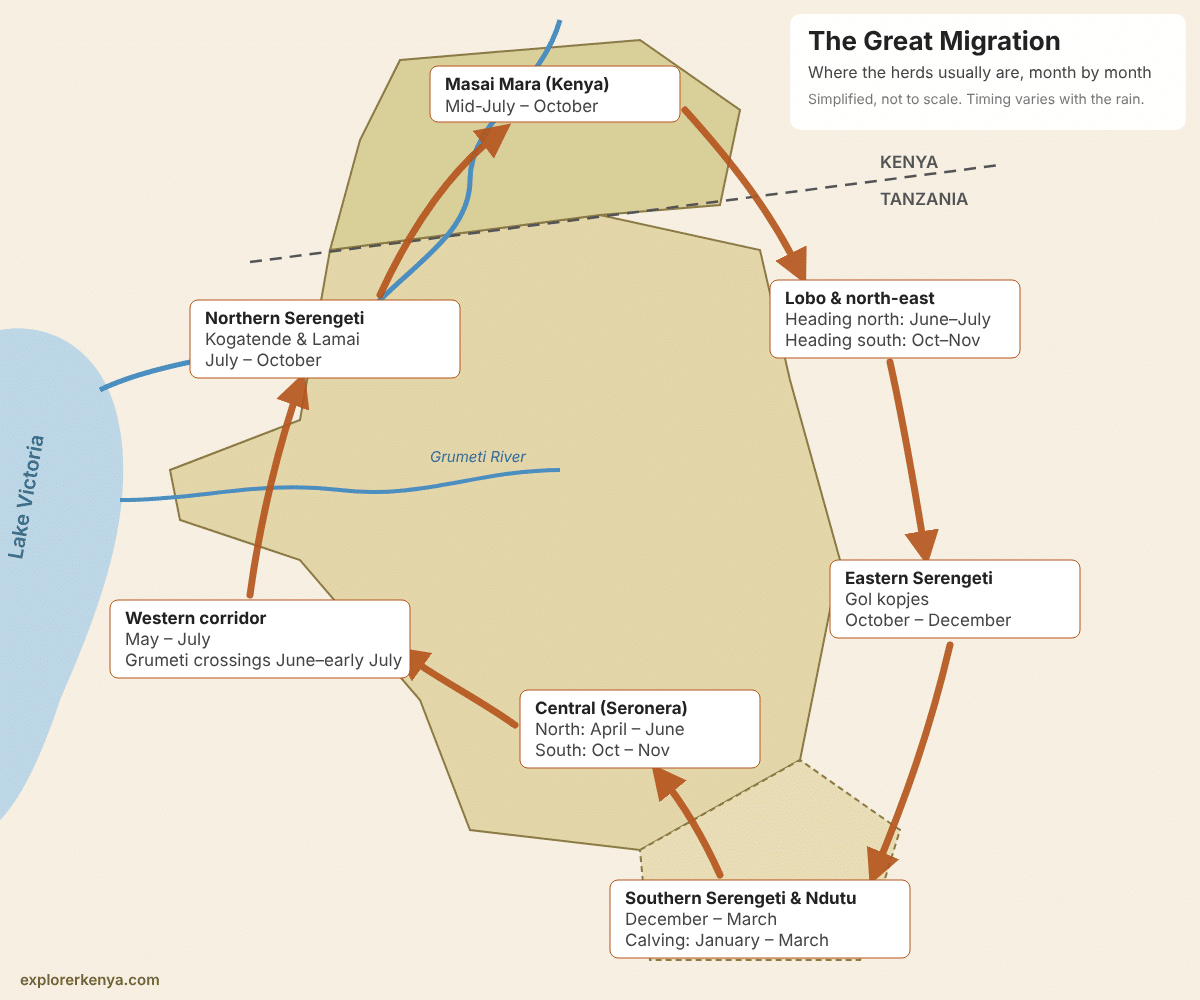
The migration in Lobo, Lamai, the Mara River and Loliondo
The northern Serengeti migration begins around June and July, as the herds leave the Grumeti area and the central Serengeti. They move fairly quickly through the Togoro plains in the north. The large kopjes here make the area popular with cheetahs, the fastest of the big cats, which can sprint at around 100 to 110 km/h in a thrilling chase. Soon the herds reach the Lobo valley, where there are more dramatic hunts by the resident lions. The valley is also a favourite haunt of the shy leopard, which mostly hides in the acacia woodland. From here the herds move north. Some cross the Mara River into the grassy, well-watered Lamai triangle at the many crossing points around Kogatende, while others continue north across the border into the Masai Mara. The Lamai triangle, protected on its southern side by the Mara River, has rich resident wildlife and is the best place in the northern Serengeti to watch the river crossings, with many crossing points. In the northern Serengeti, as in the Masai Mara, the river crossings happen from July to October and are usually best in August and September. A large part of the herds spends these months in the northern Serengeti, while others move across the border into Kenya’s Masai Mara. From October the herds turn south, either back through the Lobo area or down the eastern side of the park, depending on where the rain falls and the grass grows.

Where to stay in the northern Serengeti
The northern Serengeti offers a good range of accommodation, mostly in the luxury and standard categories. Many of the camps here are seasonal migration camps that close or move after the migration season.
Top accommodation for a northern Serengeti migration safari
Singita Mara River Tented Camp
Category: Luxury
Good for: Couples, honeymooners, families with children (10 years and above)
Singita Mara River Tented Camp is on the banks of the Mara River in the Lamai wedge. It is a short distance from major crossing points, where large numbers of wildebeest cross back and forth in search of fresh grazing. From July to October the plains around the camp can fill with big herds, creating some of the most beautiful migration scenes. With just 6 tents, the camp is ideal for a group of friends or an extended family who want the whole camp. Two of the tents have family layouts, which suits families with children.
Nyikani Migration Camp
Category: Standard
Good for: Solo travellers, couples, families with children
Nyikani is a mobile migration camp that moves between the southern Ndutu plains and the northern Serengeti. It is set up in the north, near the Mara River in the Kogatende area, from about late May to October. The herds here are an impressive sight from July to October. The camp is close to several of the main crossing points. It has 12 tents in single, twin, double, triple and family layouts. Nyikani has no age restrictions, so it is a good choice for families with young children.
Sayari Camp
Category: Luxury
Good for: Couples, honeymooners, families with children (5 years and above)
Sayari Camp is on the banks of the Mara River in the Kogatende area. It has a custom photography vehicle to help photographers get the best images of the migration, and it is a short distance from the main crossing points. The camp has 15 tents, including a family tent. Each tent is set apart, with a private veranda offering open views over the savannah and its wildlife.
Serian Serengeti
Category: Luxury
Good for: Couples, honeymooners, families with children
Serian Serengeti is in the Lamai wedge near the beautiful Wogakuria kopjes. Large herds gather on the wide grassy plains here, creating picture-perfect migration scenes. The plains around the camp are in the range of one of the Lamai lion prides, so hunts are often seen near the camp. Serian is also close to Mara River crossing points, making it a good choice for guests who want to see the crossings. The camp has just 8 tents, spaced well apart for a quiet, intimate feel, and 2 of them are family tents.
Mara Under Canvas
Category: Luxury
Good for: Couples, families with children
Mara Under Canvas, run by Tanganyika Wilderness Camps, is a mobile camp that moves with the herds during the year: to the Ndutu plains in the south from December to March (where it is known as Ndutu Under Canvas), along the herds’ route in June and July, and to the northern Serengeti from August to November. In the north it is set up close to the Mara River and its crossing points, about 30 minutes from Kogatende airstrip. The crossings near the camp are usually best in August and September. The camp has 10 tents for two or three guests and a family tent for four, made of two interconnected tents with a shared bathroom. Children are welcome.
FAQ
Is a northern Serengeti migration safari good value?
The northern Serengeti mostly has luxury migration camps and a few more affordable standard camps, so it is not the most budget-friendly region. However, guests who are happy with basic camping can stay at the Lobo campsite in the north-east, which is a very affordable option.
Why should I go on a migration safari in the northern Serengeti?
The northern Serengeti gives you a chance to watch the river crossings, with several crossing points easy to reach from the Lamai and Kogatende areas. It is also one of the quieter places to enjoy the migration, with fewer vehicles than the busiest parts of the Masai Mara or the Seronera area.
What is the weather like during the northern Serengeti migration season?
The northern migration takes place from about July to October, during the long dry season. Game viewing is excellent because the dry conditions push the herds and other wildlife towards the rivers and the remaining grazing. There is little chance of daytime rain at this time of year.
Which other places can I visit on a northern Serengeti migration safari?
The northern Serengeti is about 3 hours’ drive from Lake Victoria, the largest lake in Africa and the source of the White Nile. Here you can go on canoe trips or freshwater fishing excursions.
Ready to see the migration in the Serengeti? Explore our 7 Day Best of Tanzania Safari, or combine Kenya and Tanzania on our 6 Day Masai Mara, Serengeti and Ngorongoro Safari. For more seasonal camps, see our guide to the top migration mobile camps in the Serengeti. Contact us and we will plan the right migration safari for your dates and budget.