

The Great Wildebeest Migration is one of the few great overland migrations left in the world, which is why so many travellers want to see it. The herds move around a loop of roughly 1,000 km between the Serengeti in Tanzania and the Masai Mara in Kenya. With about 1.5 million wildebeest, and hundreds of thousands of zebras and gazelles, taking over different parts of the Mara–Serengeti ecosystem through the year, it is a breathtaking sight, full of hunts and dramatic natural scenes. In this guide we explain the key facts about the migration and what to expect in each region.
Important facts about the Great Wildebeest Migration
- The herds spread over a wide area. When the herds move into a region, they spread out over a large area, depending on where the fresh grazing is. There is no single spot in a region where all the herds gather.
- The migration doesn’t follow a single route. It is easy to imagine the herds moving along one route in a single column, but that is not how it works. The whole migration is driven by the search for fresh grazing, so when there is plenty of grass, the herds spread out and move along many routes.
- Even the direction isn’t fixed. Over the year the migration follows a clockwise loop, but that doesn’t mean every herd keeps moving in the same direction. You will often see herds moving in opposite directions, only to come together again later in the same region. For example, one herd in the Masai Mara may cross into the Mara Triangle, move into the Lamai triangle and then head down to the central and eastern Serengeti, while another herd in the Mara Triangle crosses into the main reserve and heads south-east towards the eastern Serengeti.
- Few wildebeest complete the whole loop. The loop of roughly 1,000 km is the range the herds cover, not the distance each animal walks. It is very unlikely that any single wildebeest reaches the furthest points west, north, east and south in one year.
- The river crossing is not a single event. Some travel websites say the Mara River crossing happens only once, over a short period. In fact, a single herd may cross the Mara River four times or more as it follows the grazing on either side of the river. The Mara River crossings take place from July to October, and in some years the first crossings come a little earlier.
- The timing in each region can’t be predicted exactly. Month-by-month guides to the migration, including ours, are estimates. The herds can arrive earlier or later depending on the rains: if the rains come early, the movement comes early, and if they are late, so are the herds. The migration can also be delayed by human activity, such as fences that block old routes.
- The herds don’t all arrive at the same time. Different herds reach a new region at different times, depending on how far they have come and how much grazing they find along the way. For example, some herds reach the southern plains for the calving season in December, while others arrive in January.
- Not all the herds reach the Masai Mara. Some websites say that all the herds gather in the Masai Mara in July and August. In reality, a large part of the herds stays in the northern Serengeti during these months, while others move across the border into the Masai Mara. How many reach the Mara changes from year to year, depending on where the grazing is.
The Great Wildebeest Migration cycle
Southern Serengeti
When: December to March
Where: The Ndutu area, the southern Serengeti and the Maswa Game Reserve
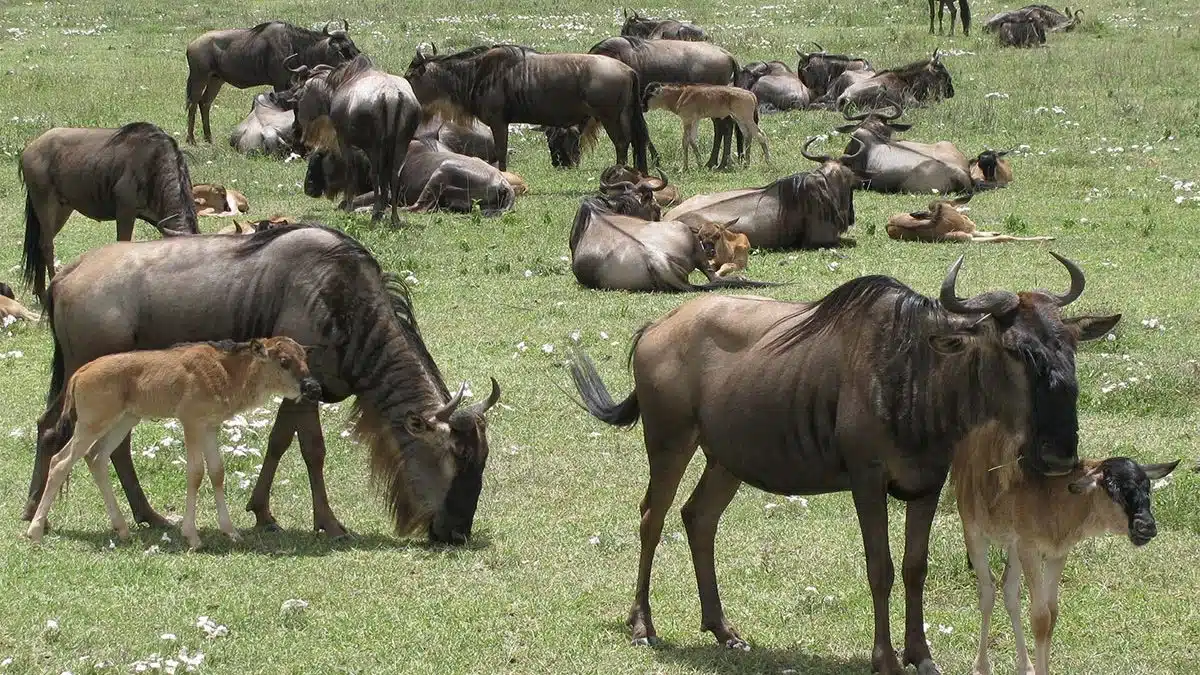
This is the calving season, when the herds give birth. The herds spread across the southern plains, south of the Mbalageti River, with the biggest concentrations usually around Ndutu in the Ngorongoro Conservation Area. Their range can stretch as far as the Maswa Game Reserve. Calving runs from about January to March, peaking in February.
Central and western Serengeti
When: April to July
Where: Seronera, the western corridor, the Grumeti and Ikorongo reserves and the Ikona Wildlife Management Area
After the calving season, the herds move north-west. The long rains bring plenty of grass, so the herds spread widely, some through the Seronera valley in the central Serengeti and others into the western corridor. The herds are in the central Serengeti from about April to June and in the western corridor from about May to July, and the Grumeti River crossings usually take place from June to early July.
Northern Serengeti and the Masai Mara
When: July to October
Where: Lamai, Kogatende, the Lobo valley, the Masai Mara, the Mara Triangle and Mara North
The arrival of the herds in the northern Serengeti marks the start of the Mara River crossings. From July the herds spread across the northern Serengeti, and from about mid-July they also move into the Masai Mara. The crossings take place at many points on both sides of the border, usually best in August and September, and they continue into October, when the last herds cross back from the Lamai triangle and head south.
Eastern Serengeti
When: October to November
Where: Loliondo, the eastern Serengeti and the eastern side of Seronera
After the northern migration, the herds move south-east, spreading between the north-eastern and south-eastern Serengeti. There are no big crossings here, apart from smaller streams that feed the Grumeti River, but the big cats of the eastern plains, especially cheetahs and lions, make for exciting hunting scenes. The migration here feels wild and authentic, with only a few camps, mostly luxury ones on the eastern side of the central Serengeti, and you will rarely see other vehicles on your game drives. From here the herds move on to the southern plains around Ndutu, ready for the next calving season.
Ready to see the migration in the Serengeti? Explore our 7 Day Best of Tanzania Safari, or combine Kenya and Tanzania on our 6 Day Masai Mara, Serengeti and Ngorongoro Safari. Read next: When to Go for the Great Wildebeest Migration: Month by Month. Contact us and we will plan the right migration safari for your dates and budget.